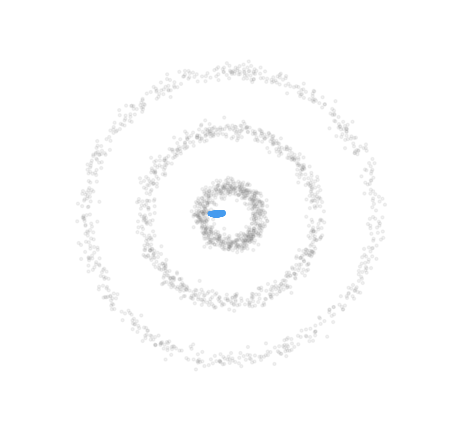
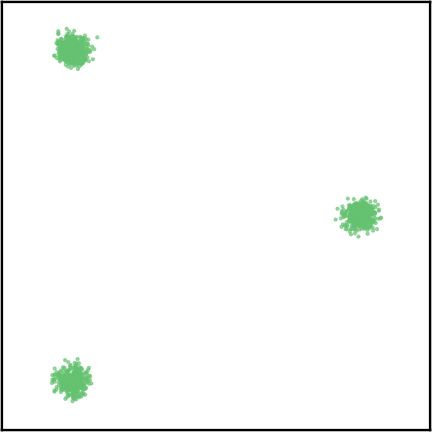
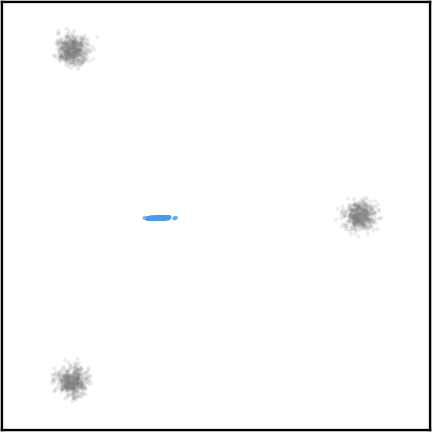
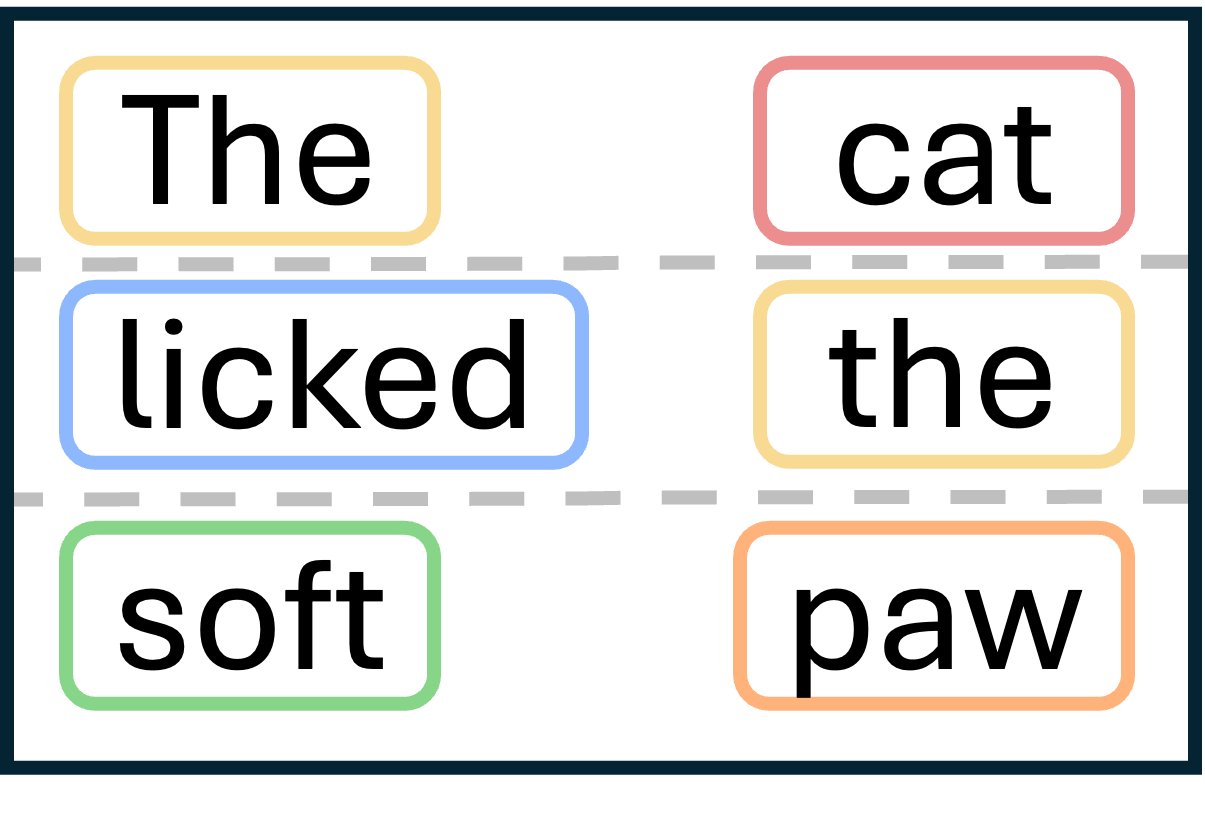
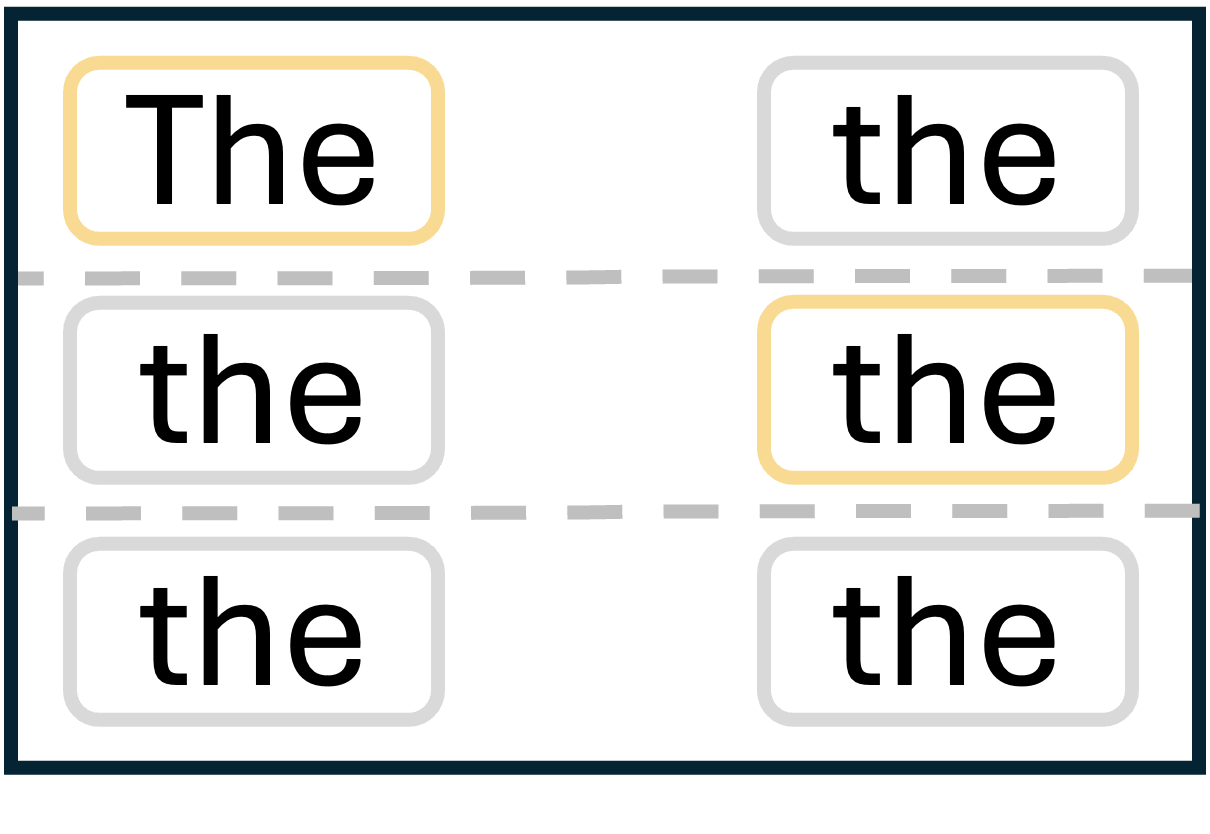
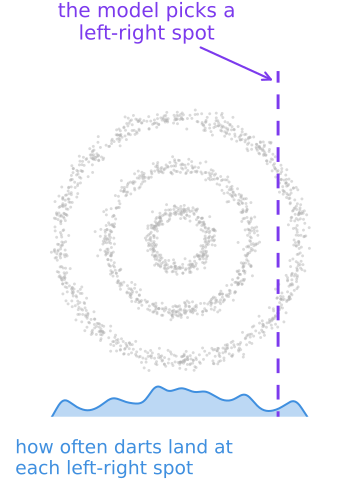
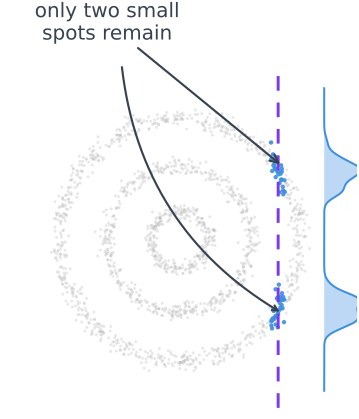
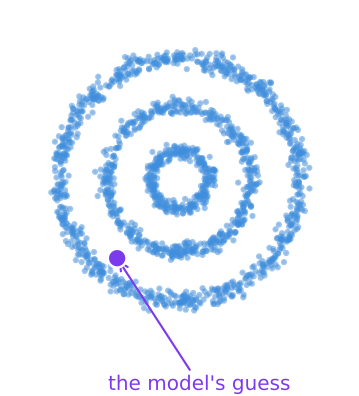
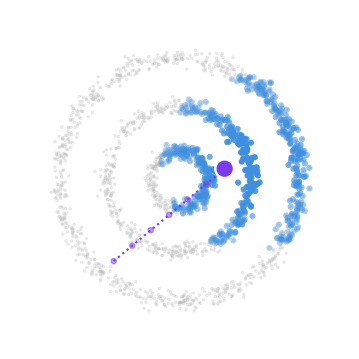
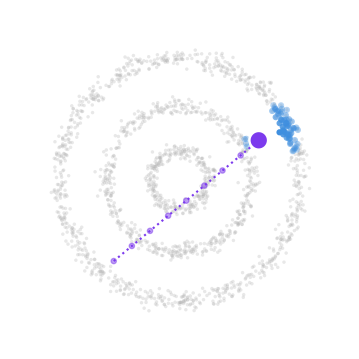
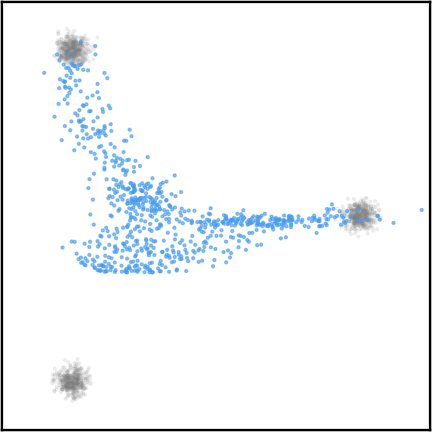
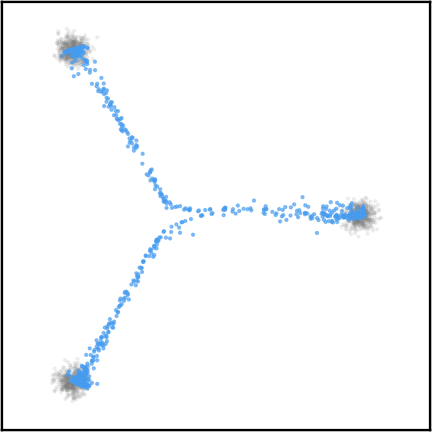
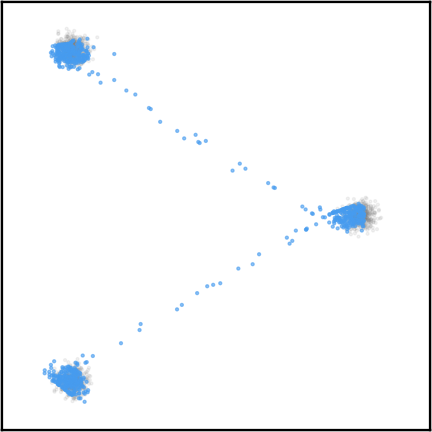
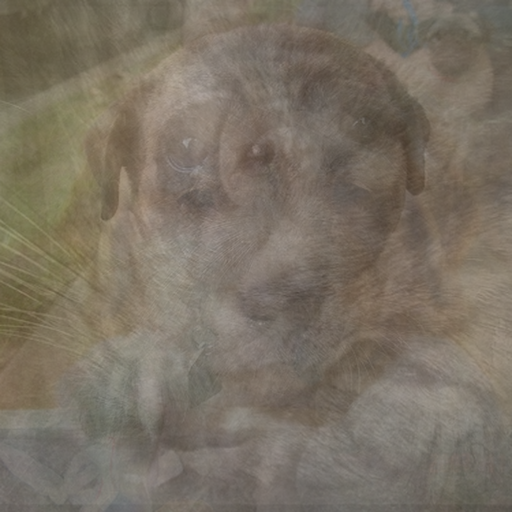
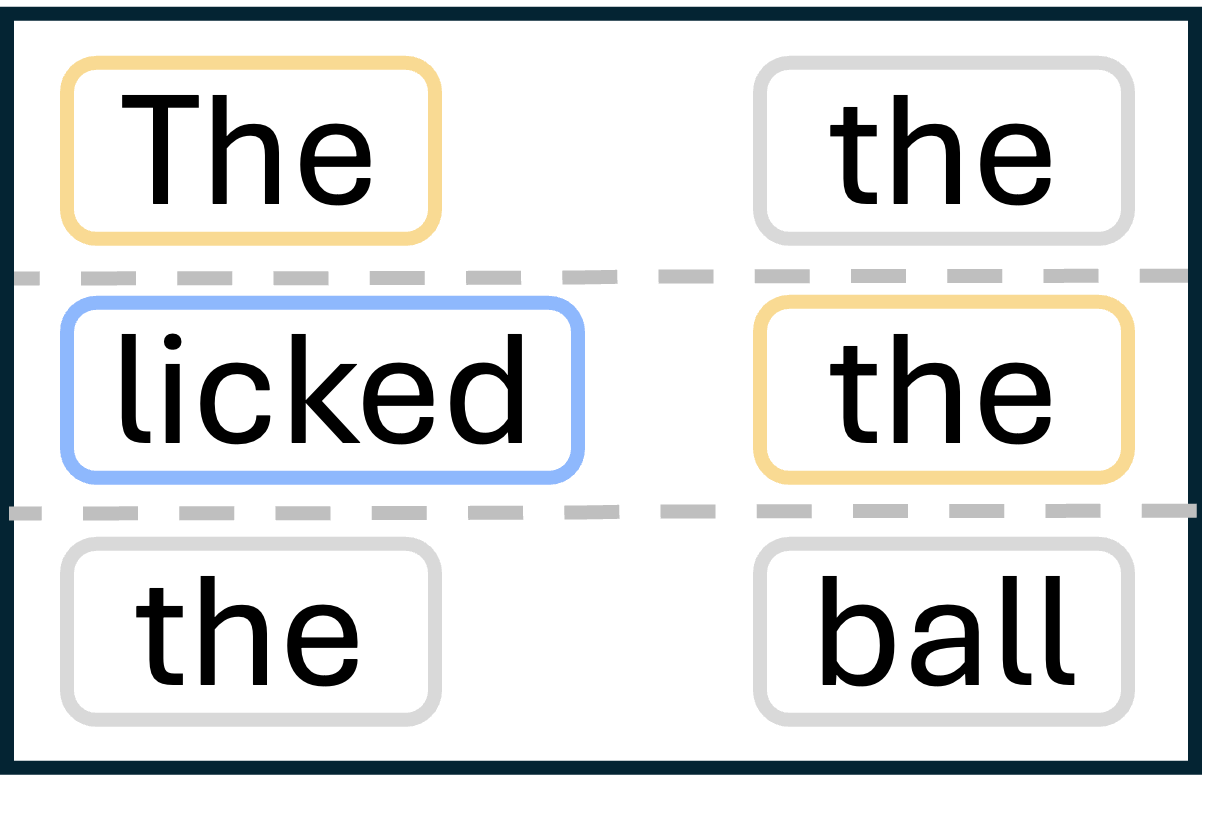
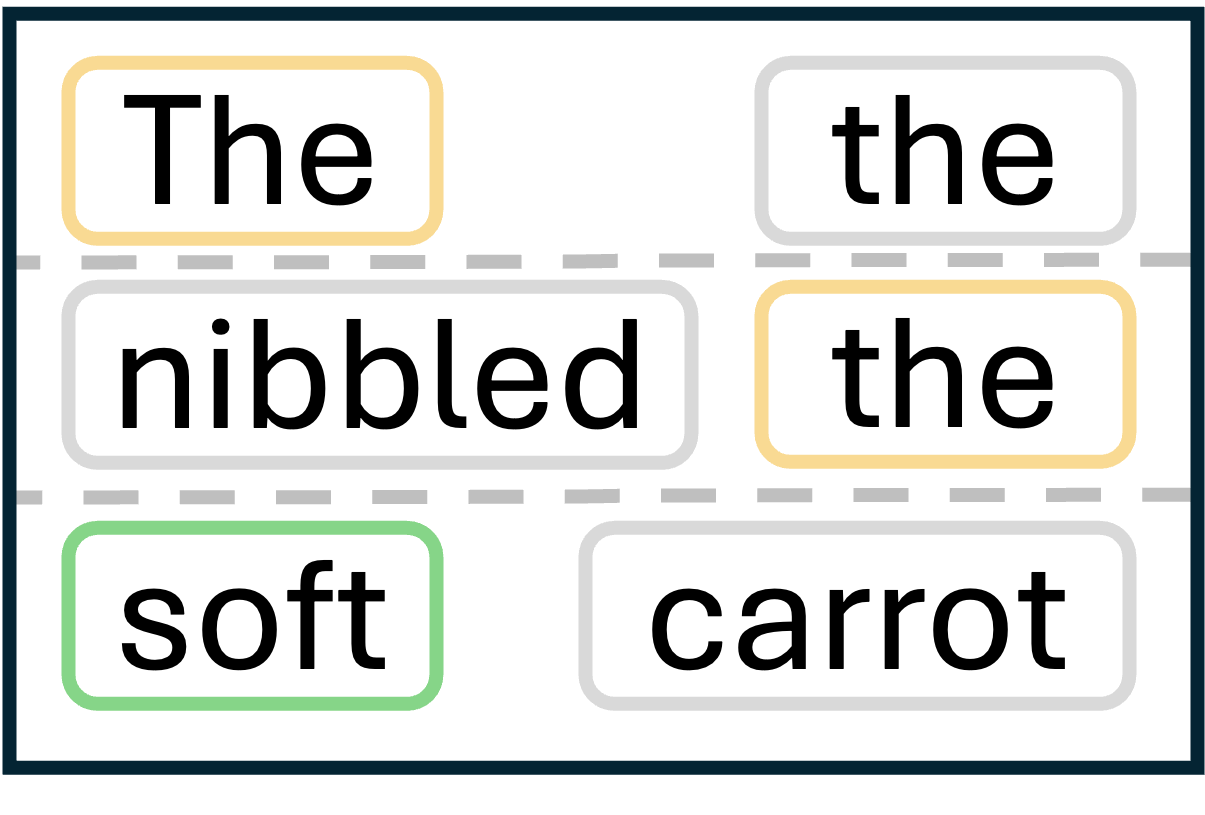
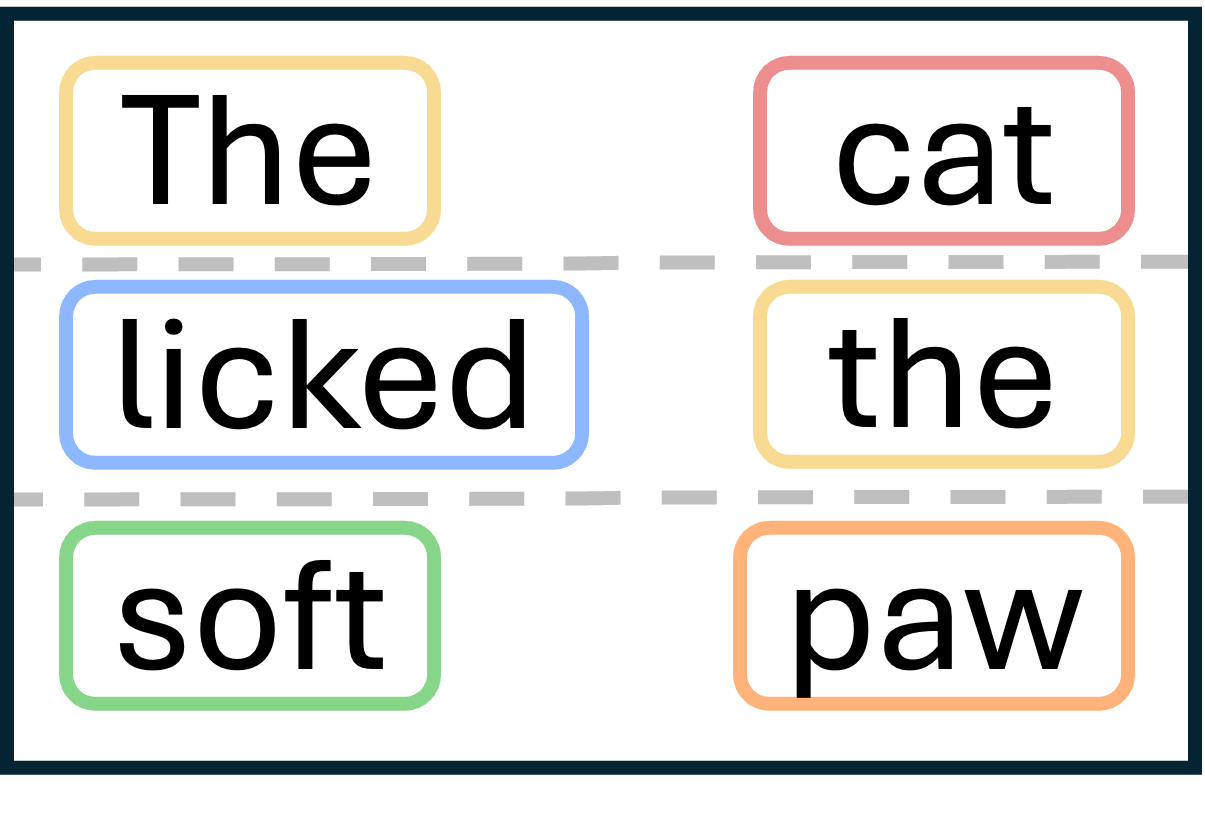
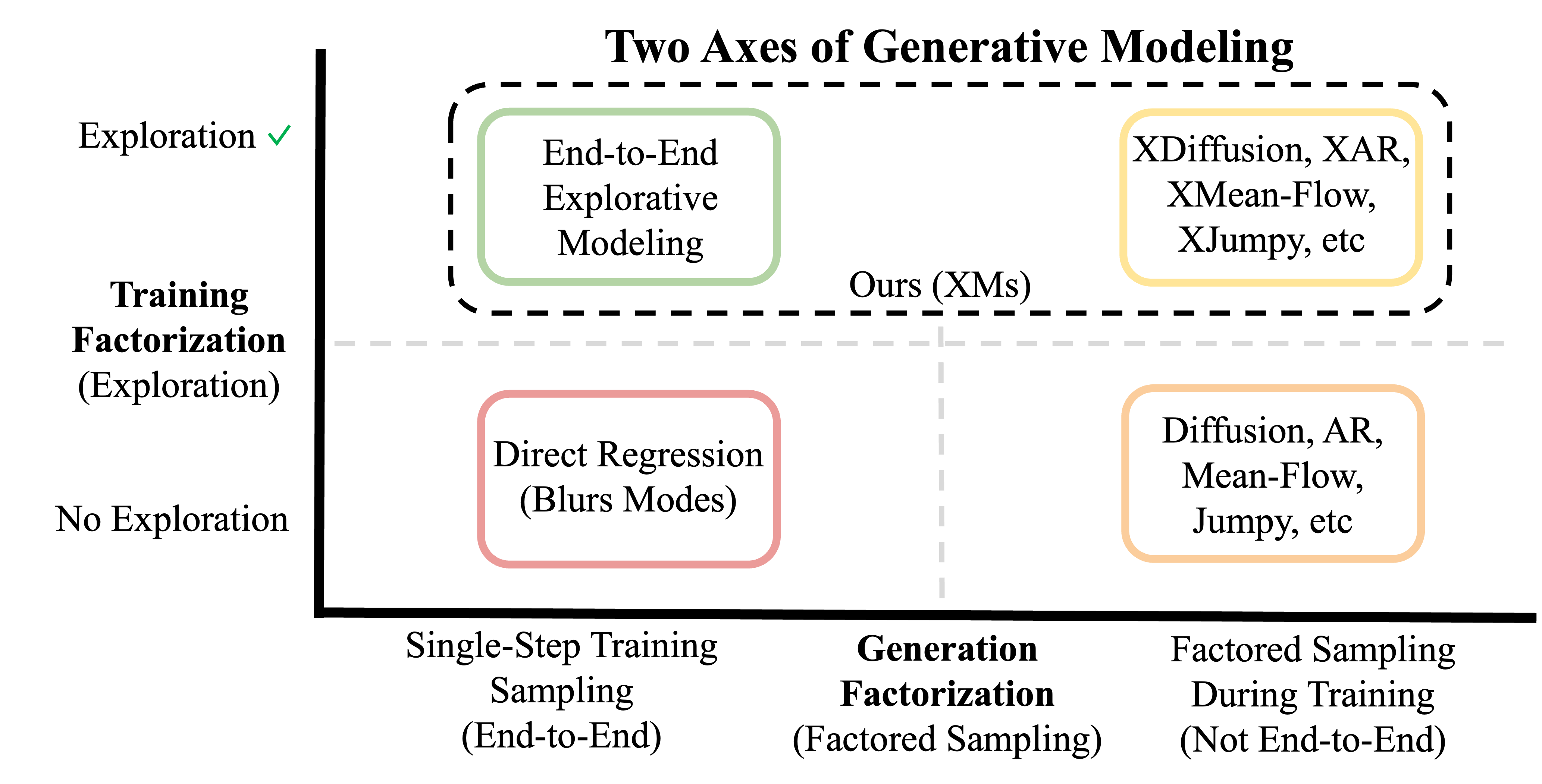
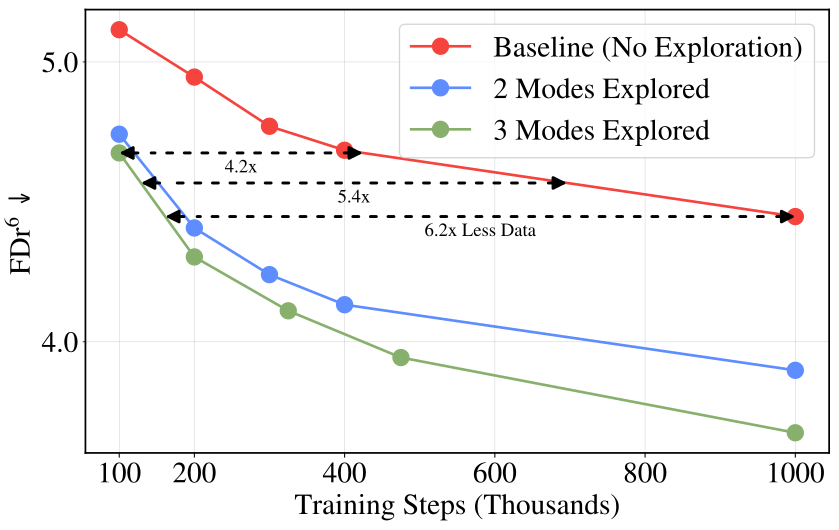
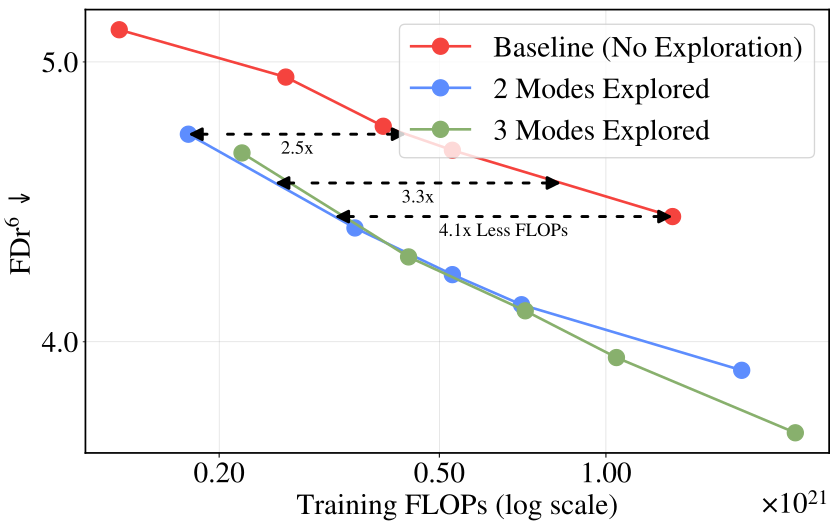
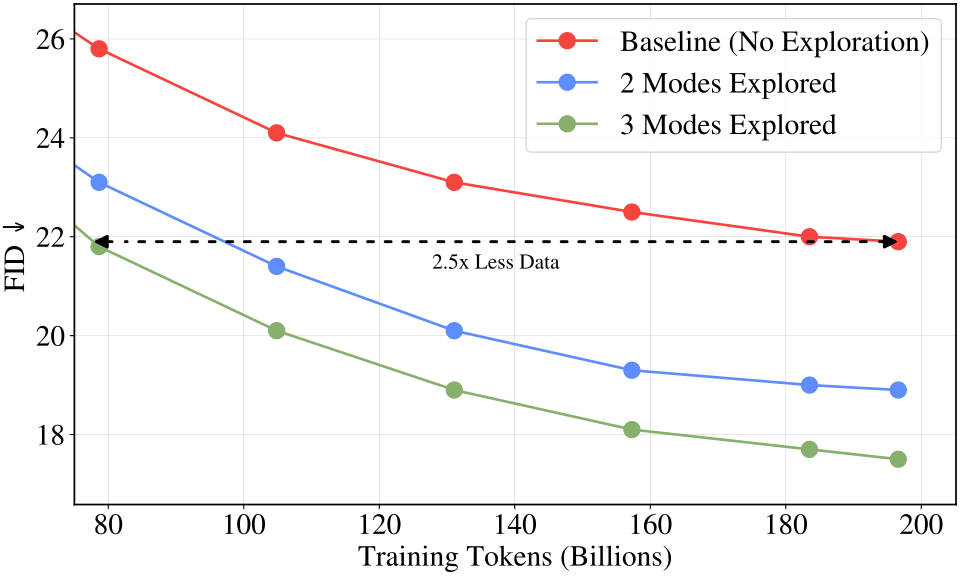
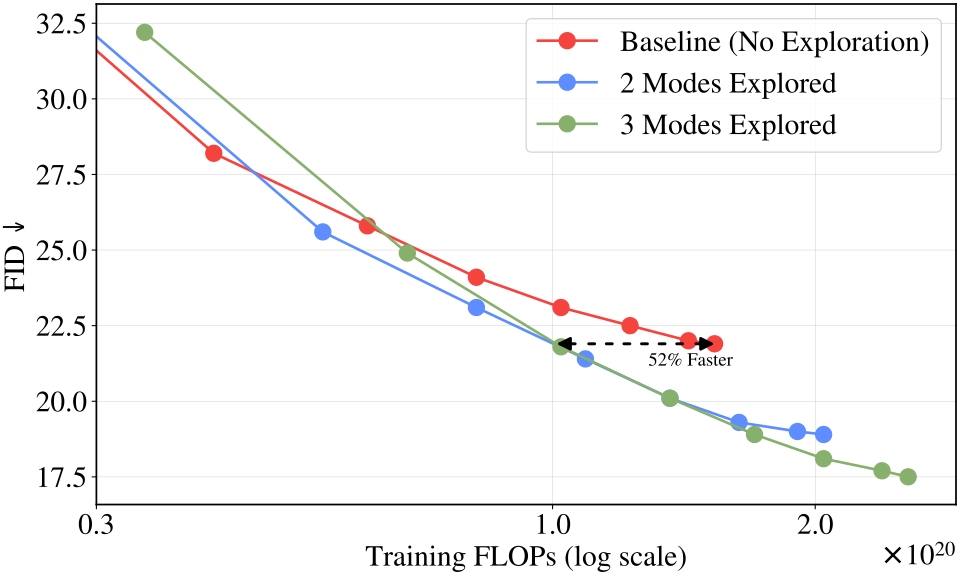
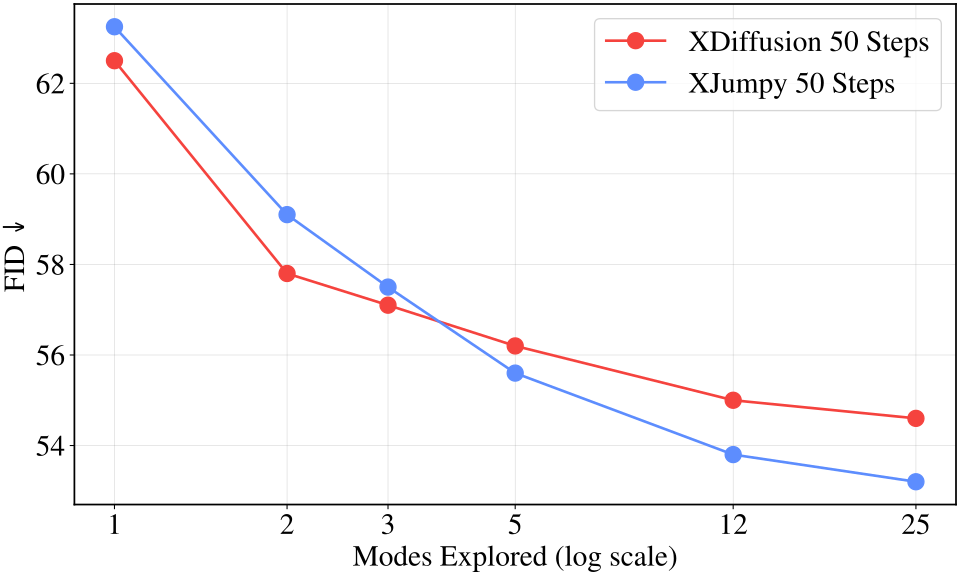
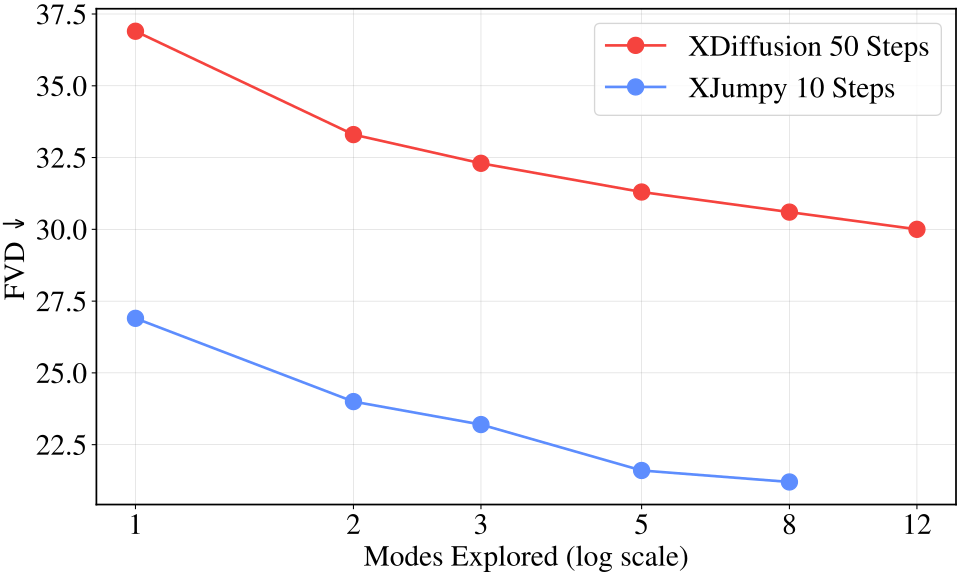
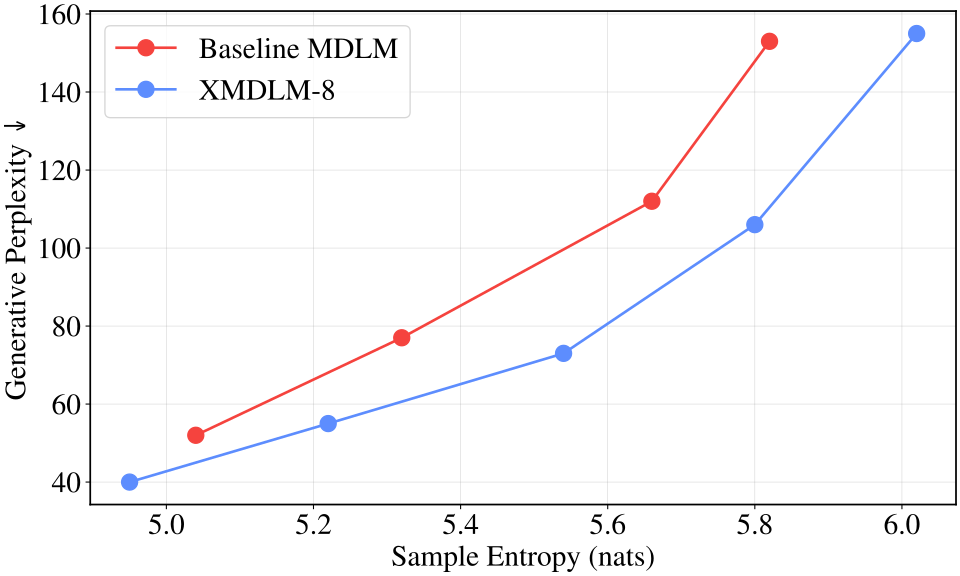
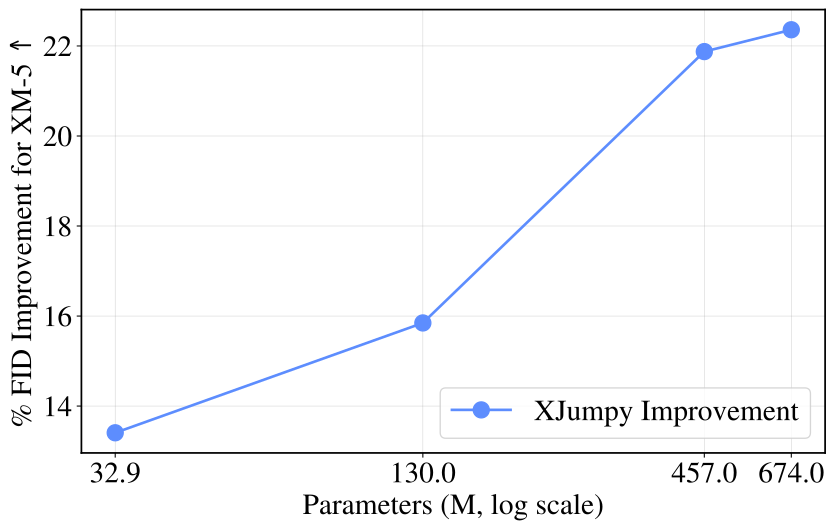
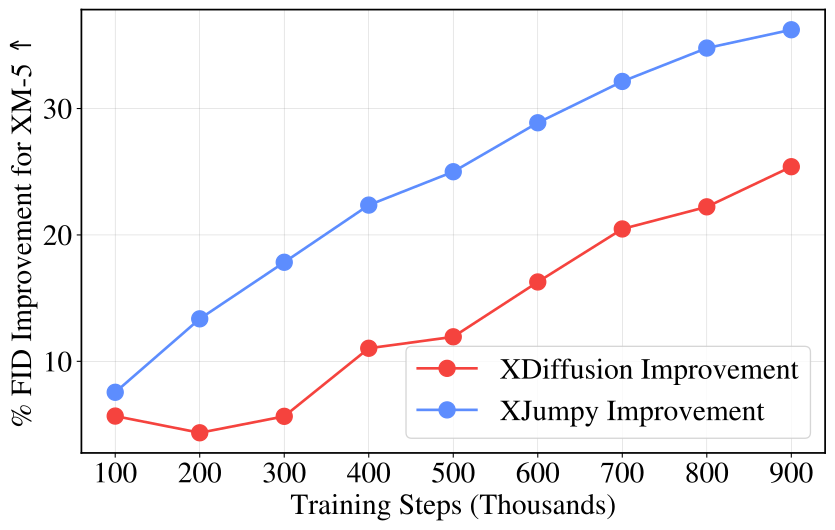
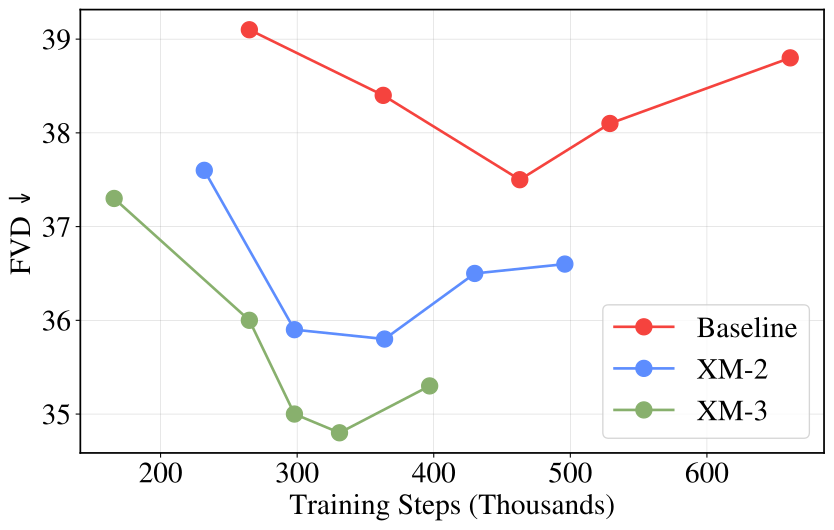
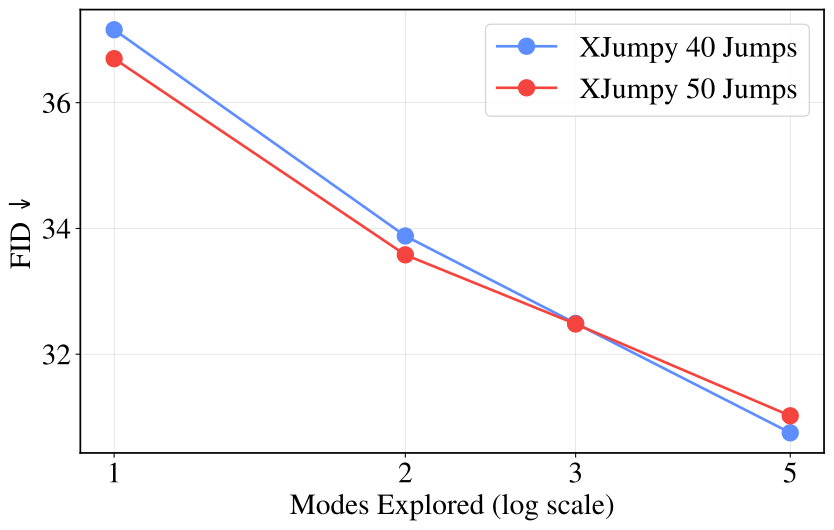
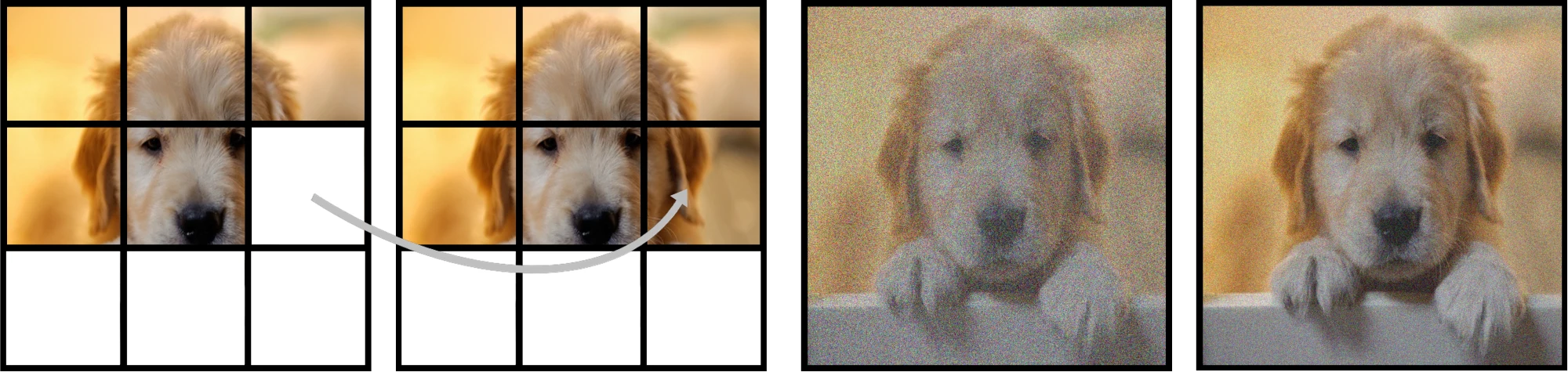
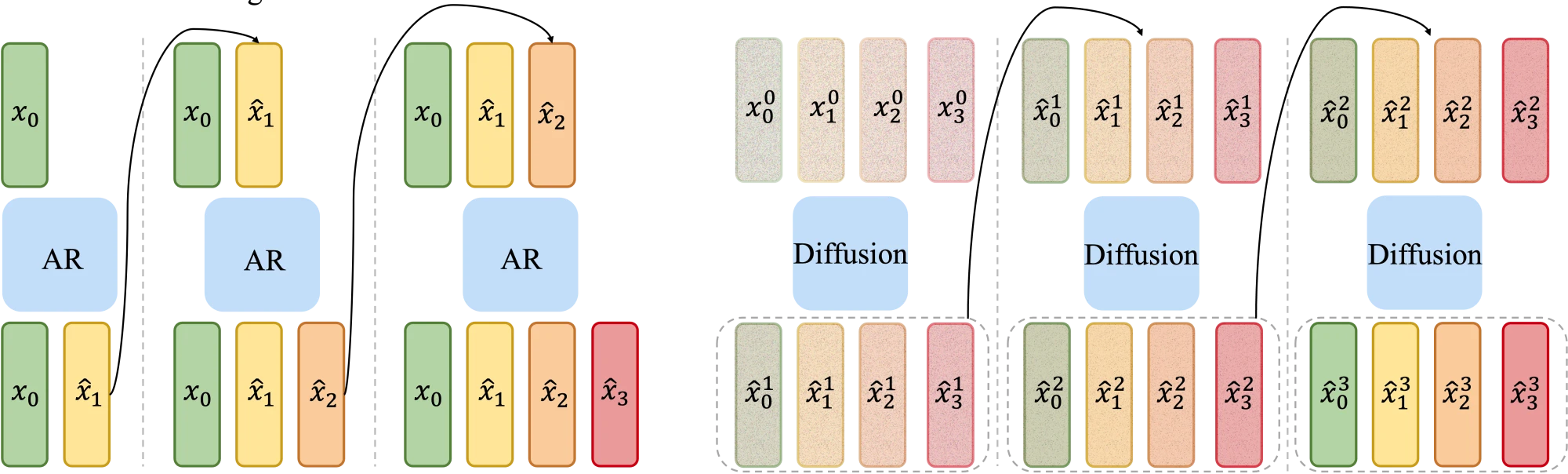
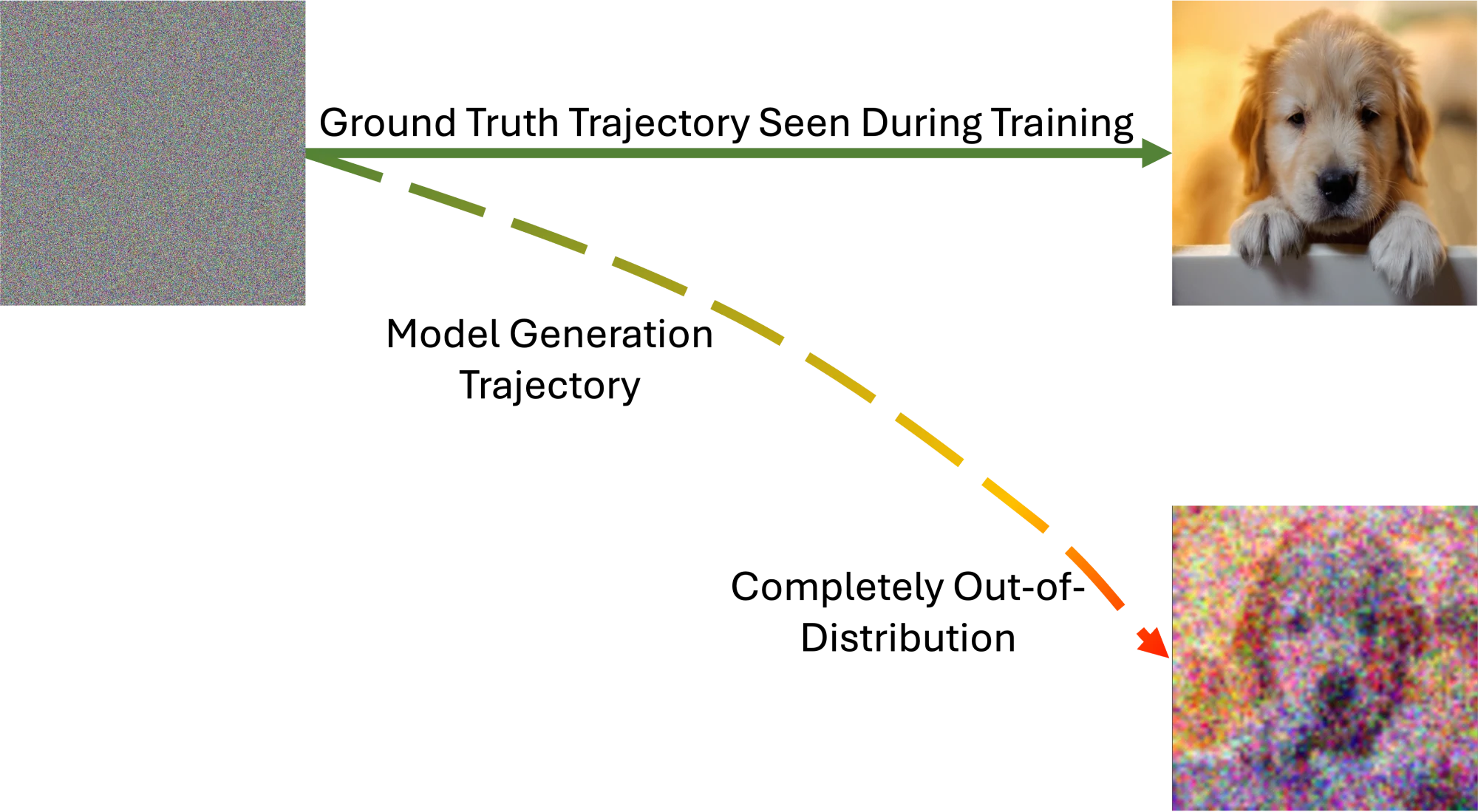
<?xml version="1.0" encoding="utf-8"?><feed xmlns="http://www.w3.org/2005/Atom" xml:lang="en"><generator uri="https://jekyllrb.com/" version="4.4.1">Jekyll</generator><link href="https://alexiglad.github.io/feed.xml" rel="self" type="application/atom+xml"/><link href="https://alexiglad.github.io/" rel="alternate" type="text/html" hreflang="en"/><updated>2026-08-13T18:32:06+00:00</updated><id>https://alexiglad.github.io/feed.xml</id><title type="html">blank</title><subtitle>Alexi Gladstone&apos;s official website. </subtitle><entry><title type="html">Explorative Modeling – Unlocking a Third Pretraining Axis and End-to-End Generation</title><link href="https://alexiglad.github.io/blog/2026/explorative_modeling/" rel="alternate" type="text/html" title="Explorative Modeling – Unlocking a Third Pretraining Axis and End-to-End Generation"/><published>2026-07-29T00:00:00+00:00</published><updated>2026-07-29T00:00:00+00:00</updated><id>https://alexiglad.github.io/blog/2026/explorative_modeling</id><content type="html" xml:base="https://alexiglad.github.io/blog/2026/explorative_modeling/"><![CDATA[<p><a href="https://explorative-modeling.github.io/">Website: https://explorative-modeling.github.io/</a> <a href="https://github.com/alexiglad/XM">GitHub: https://github.com/alexiglad/XM</a></p> <p><strong>TLDR</strong>: We introduce Explorative Modeling, a new paradigm for generative modeling that acts as a third pretraining axis when added to existing generative models, and also enables end-to-end generation. Increasing exploration monotonically improves existing models across images, video, and language, and the gains grow with scale (7%→36% with data, 13%→23% with parameters). Concretely, Explorative Models (XMs) reach 6.2× sample efficiency, 4.1× FLOP efficiency, and 47% better parameter efficiency. Exploration also enables scaling generalization, and scaling how end-to-end existing models are. As end-to-end generative models, XMs match diffusion on control tasks with up to 256× less inference compute.</p> <p>Let me start with a question that sounds simple. If I ask a model to “generate a dog”, how many correct answers are there?</p> <p>It turns out there are a lot… likely billions or more images that we could count as dog images.</p> <p>So what happens if we train a neural network to directly predict dog images? The model sees thousands of different valid dogs during training, and the single prediction closest to all of them is their average. That’s what the model learns to output, and the average of thousands of dogs looks nothing like a dog, it’s a brown blur.</p> <figure class="text-center"> <div style="display:flex; justify-content:center; align-items:center; gap:14px; flex-wrap:wrap;"> <div style="width:36%; min-width:180px;"><img src="/assets/img/blog/xm/pred_images_ground_truth.png" style="width:100%;" alt="A real dog from the training data"/><div style="font-size:0.85em;">A real dog from the data</div></div> <div style="font-size:2.2em; color:#888;">&#8594;</div> <div style="width:36%; min-width:180px;"><img src="/assets/img/blog/xm/pred_images_xm_k1.png" style="width:100%;" alt="The brown blur a model predicts when trained to directly predict images"/><div style="font-size:0.85em;">What the model predicts</div></div> </div> <figcaption>Figure 1: Training a model to directly predict images gives you the average of them all, a brown blur. This is why direct regression doesn't work for generative modeling.</figcaption> </figure> <p>To make this concrete, let’s play a game. I’m going to throw darts at the board below, and each dart will land somewhere random on the rings. Your job is to guess where my next dart will land, and the further off you are, the worse your score.</p> <figure class="text-center"> <img src="/assets/img/blog/xm/dartboard_ground_truth.svg" alt="The dartboard: darts land at random around three rings" width="320"/> <figcaption>Figure 2: The dartboard for our game.</figcaption> </figure> <p>So where should you guess? It turns out the guess that minimizes your error is the exact middle of the board.<sup id="fnref:1"><a href="#fn:1" class="footnote" rel="footnote" role="doc-noteref">1</a></sup> We trained a model to play this game, and sure enough, it guesses the middle every time (this is the <em>optimal</em> prediction here)!</p> <figure class="text-center"> <img src="/assets/img/blog/xm/dartboard_direct_regression.svg" alt="A model trained to predict dart landing spots with a single guess predicts the middle of the board, where darts almost never land" width="450"/> <figcaption>Figure 3: A model playing our game (blue) guesses the middle of the board.</figcaption> </figure> <p>This is terrible though… the middle is almost never where a dart actually lands. The “optimal” guess is a spot that no darts ever land.</p> <p><em>This is the core problem of generative modeling.</em> When a prediction has many valid answers, the best single prediction is their <em>average</em>, and the average of data is generally a bad answer that looks nothing like the real data.<sup id="fnref:2"><a href="#fn:2" class="footnote" rel="footnote" role="doc-noteref">2</a></sup></p> <p>And this problem isn’t special to dartboards or dogs, it shows up with any kind of data. When we trained a model to directly generate three piles of 2D points, it predicted a single dot in the middle of them, and when we trained one on text, all it could say was “the”.</p> <figure class="text-center"> <div style="display:flex; justify-content:center; align-items:flex-end; gap:16px; flex-wrap:wrap;"> <div style="width:180px;"><img src="/assets/img/blog/xm/piles_3_ground_truth.svg" alt="Ground truth 2D points" style="width:100%;"/><div style="font-size:0.85em;">Real data</div></div> <div style="width:180px;"><img src="/assets/img/blog/xm/piles_3_xm_k1.svg" alt="Naive model predicts a single dot" style="width:100%;"/><div style="font-size:0.85em;">What the model predicts</div></div> <div style="width:180px;"><img src="/assets/img/blog/xm/xmdlm_ground_truth.png" alt="Ground truth text" style="width:100%;"/><div style="font-size:0.85em;">Real data</div></div> <div style="width:180px;"><img src="/assets/img/blog/xm/xmdlm_k1.png" alt="Naive language model only says the word the" style="width:100%;"/><div style="font-size:0.85em;">What the model predicts</div></div> </div> <figcaption>Figure 4: Direct prediction collapses to the average on any kind of data.</figcaption> </figure> <p>But wait. ChatGPT writes coherent text, and image models generate really amazing images. Clearly this problem has been solved somehow, right?</p> <p>It has, and every scalable generative model today solves it the same way, <em>by breaking generation into many small steps during training, so each step has roughly one right answer</em>. When a step has one right answer, there’s nothing to average, and the blur disappears.</p> <p>Let’s look at how this works. Autoregressive models (like LLMs) predict one piece at a time, which in our game means never guessing the dart’s exact position all at once. Instead, you first guess only how far left or right the dart lands, and then given that, you guess how far up or down. Once you know the dart landed on the far right, there are only a couple places it could be.</p> <figure class="text-center"> <div style="display:flex; justify-content:center; align-items:flex-start; gap:10px; flex-wrap:wrap;"> <div style="width:44%; min-width:250px;"><img src="/assets/img/blog/xm/dartboard_ar_step1.svg" style="width:100%;" alt="Step 1: predict only the left-right position"/><div style="font-size:0.85em;">Step 1: pick a left-right spot</div></div> <div style="width:44%; min-width:250px;"><img src="/assets/img/blog/xm/dartboard_ar_step2.svg" style="width:100%;" alt="Step 2: given the left-right position, only two small spots remain for up-down"/><div style="font-size:0.85em;">Step 2: pick up-down, given left-right</div></div> </div> <figcaption>Figure 5: Autoregression predicts one sequence element at a time. In our game, once the left-right position is chosen, the up-down prediction only has two small spots left to choose from.</figcaption> </figure> <p>Diffusion models do this differently. They start from pure random noise and take hundreds of tiny steps toward the data. Early on, their guess could still become any dart, but every step narrows the possibilities, so no single step ever faces many valid answers at once.</p> <figure class="text-center"> <div style="display:flex; justify-content:center; align-items:flex-start; gap:8px; flex-wrap:wrap;"> <div style="width:31%; min-width:200px;"><img src="/assets/img/blog/xm/dartboard_diffusion_1.svg" style="width:100%;" alt="Start of denoising: the guess is pure noise and could still become any dart"/><div style="font-size:0.85em;">Start: could become any dart</div></div> <div style="width:31%; min-width:200px;"><img src="/assets/img/blog/xm/dartboard_diffusion_2.svg" style="width:100%;" alt="Partway through denoising: fewer areas remain"/><div style="font-size:0.85em;">Partway: fewer areas remain</div></div> <div style="width:31%; min-width:200px;"><img src="/assets/img/blog/xm/dartboard_diffusion_3.svg" style="width:100%;" alt="Near the end of denoising: mostly one small area remains"/><div style="font-size:0.85em;">Near the end: pinned down</div></div> </div> <figcaption>Figure 6: Diffusion takes small steps from noise to data. Blue shows the darts the model's guess (purple) could still become, which narrows with every step.</figcaption> </figure> <p>It turns out this is basically how every modern generative model works, by breaking the generation process into smaller pieces that can be predicted well. This includes LLMs, image and video models, and even newer few-step models like MeanFlow and consistency models. We refer to this idea of breaking generation into pieces as <em>factoring generation</em>.</p> <p>This approach of factoring generation works, but it’s also evil for a couple of reasons. The first is that models get trained on a single step, yet run for hundreds or thousands of steps at inference, so their own imperfect outputs get fed back in as inputs, errors compound, and generations slowly drift away from anything the model saw during training. This problem is called exposure bias (I wrote a <a href="/blog/2026/exposure_bias/">whole blog on why it’s evil</a>), and it’s why video models melt into mush after ten seconds and why LLMs get less coherent over really long generations, directly hurting performance and generalization.</p> <p>The second evil builds on the first, because that mismatch between training and inference means these models are never <em>end-to-end</em>, where an end-to-end model runs at inference exactly the way it was trained. End-to-end learning is what kicked off the deep learning revolution with AlexNet, and the lesson has held ever since… letting models learn everything directly from data beats hand-designing parts of the pipeline, and a model that runs the way it was trained is never forced into out-of-distribution territory. Nearly all of deep learning has gone end-to-end by now except generative modeling, and factoring generation is exactly what’s blocking it.</p> <p>So ideally we’d stop factoring generation, but factoring is also the only trick we know that handles the many-answers problem. The natural question then is whether we could factor something else instead, and it turns out a generative model only has two processes, how it generates and how it trains. If generation is off the table, that leaves the training loop.</p> <p>So what does factoring training look like? To answer this, let’s go back to our game, except this time I’ll give you twenty guesses instead of one, and only your closest guess counts. It turns out that with twenty guesses, guessing the middle becomes a terrible strategy. This is because you can now spread your guesses over the spots where darts actually land, lowering your error far more than the middle ever could. In other words, the winning strategy is to use your guesses to <em>explore</em> different answers.</p> <p>And this is exactly what happens. When we train a model this way with twenty guesses (middle panel below), its guesses spread across the board!</p> <figure class="text-center"> <div style="display:flex; justify-content:center; align-items:flex-end; gap:8px; flex-wrap:wrap;"> <div style="width:31%; min-width:160px;"><img src="/assets/img/blog/xm/dartboard_xm_bok_2.svg" style="width:100%;" alt="XM with 2 guesses"/><div style="font-size:0.8em;">2 guesses</div></div> <div style="width:31%; min-width:160px;"><img src="/assets/img/blog/xm/dartboard_xm_bok_20.svg" style="width:100%;" alt="XM with 20 guesses"/><div style="font-size:0.8em;">20 guesses</div></div> <div style="width:31%; min-width:160px;"><img src="/assets/img/blog/xm/dartboard_xm_bok_200.svg" style="width:100%;" alt="XM with 200 guesses"/><div style="font-size:0.8em;">200 guesses</div></div> </div> <figcaption>Figure 7: When only the closest guess counts, guesses spread across the board instead of averaging.</figcaption> </figure> <p>Take a second to appreciate what just happened here. The darts land in the exact same places as before, but because we changed <em>how guesses are scored</em>, the best possible prediction moved from the middle of the board onto the spots darts actually land. This reveals something important, which is that the training objective alone controls what the best prediction is (the loss minimizer), and by changing it, we moved the loss minimizer from the average of the data onto the data itself.</p> <p>This is <strong>Explorative Modeling</strong>. At each training step, the model explores <em>K</em> possible matches between what it generates and the real data, and only the best match gets trained. We call models trained this way <strong>Explorative Models (XMs)</strong>. In the simplest case, this is literally, beautifully, a for loop:</p> <div class="language-python highlighter-rouge"><div class="highlight"><pre class="highlight"><code><span class="n">losses</span> <span class="o">=</span> <span class="p">[]</span>
<span class="k">for</span> <span class="n">i</span> <span class="ow">in</span> <span class="nf">range</span><span class="p">(</span><span class="n">K</span><span class="p">):</span>
    <span class="n">generation</span> <span class="o">=</span> <span class="n">model</span><span class="p">.</span><span class="nf">generate</span><span class="p">()</span>  <span class="c1"># e.g., from a different random noise
</span>    <span class="n">losses</span><span class="p">.</span><span class="nf">append</span><span class="p">(</span><span class="nf">loss_fn</span><span class="p">(</span><span class="n">generation</span><span class="p">,</span> <span class="n">data</span><span class="p">))</span>
<span class="nf">min</span><span class="p">(</span><span class="n">losses</span><span class="p">).</span><span class="nf">backward</span><span class="p">()</span>  <span class="c1"># only the best generation gets gradients
</span></code></pre></div></div> <p>Here’s what happens as we increase the exploration <em>K</em> on real data:</p> <figure class="text-center"> <div style="display:flex; justify-content:center; align-items:flex-end; gap:6px; flex-wrap:wrap;"> <div style="width:19%; min-width:110px;"><img src="/assets/img/blog/xm/piles_3_ground_truth.svg" style="width:100%;" alt="ground truth piles"/><div style="font-size:0.75em;">Ground Truth</div></div> <div style="width:19%; min-width:110px;"><img src="/assets/img/blog/xm/piles_3_xm_k1.svg" style="width:100%;" alt="K=1"/><div style="font-size:0.75em;">K=1 (no exploration)</div></div> <div style="width:19%; min-width:110px;"><img src="/assets/img/blog/xm/piles_3_xm_k2.svg" style="width:100%;" alt="K=2"/><div style="font-size:0.75em;">K=2</div></div> <div style="width:19%; min-width:110px;"><img src="/assets/img/blog/xm/piles_3_xm_k5.svg" style="width:100%;" alt="K=5"/><div style="font-size:0.75em;">K=5</div></div> <div style="width:19%; min-width:110px;"><img src="/assets/img/blog/xm/piles_3_xm_k50.svg" style="width:100%;" alt="K=50"/><div style="font-size:0.75em;">K=50</div></div> </div> <div style="display:flex; justify-content:center; align-items:flex-end; gap:6px; flex-wrap:wrap; margin-top:8px;"> <div style="width:19%; min-width:110px;"><img src="/assets/img/blog/xm/pred_images_ground_truth.png" style="width:100%;" alt="ground truth images"/><div style="font-size:0.75em;">Ground Truth</div></div> <div style="width:19%; min-width:110px;"><img src="/assets/img/blog/xm/pred_images_xm_k1.png" style="width:100%;" alt="K=1"/><div style="font-size:0.75em;">K=1 (no exploration)</div></div> <div style="width:19%; min-width:110px;"><img src="/assets/img/blog/xm/pred_images_xm_k5.png" style="width:100%;" alt="K=5"/><div style="font-size:0.75em;">K=5</div></div> <div style="width:19%; min-width:110px;"><img src="/assets/img/blog/xm/pred_images_xm_k20.png" style="width:100%;" alt="K=20"/><div style="font-size:0.75em;">K=20</div></div> <div style="width:19%; min-width:110px;"><img src="/assets/img/blog/xm/pred_images_xm_k50.png" style="width:100%;" alt="K=50"/><div style="font-size:0.75em;">K=50</div></div> </div> <div style="display:flex; justify-content:center; align-items:flex-end; gap:6px; flex-wrap:wrap; margin-top:8px;"> <div style="width:19%; min-width:110px;"><img src="/assets/img/blog/xm/xmdlm_ground_truth.png" style="width:100%;" alt="ground truth text"/><div style="font-size:0.75em;">Ground Truth</div></div> <div style="width:19%; min-width:110px;"><img src="/assets/img/blog/xm/xmdlm_k1.png" style="width:100%;" alt="K=1"/><div style="font-size:0.75em;">K=1 (no exploration)</div></div> <div style="width:19%; min-width:110px;"><img src="/assets/img/blog/xm/xmdlm_k2.png" style="width:100%;" alt="K=2"/><div style="font-size:0.75em;">K=2</div></div> <div style="width:19%; min-width:110px;"><img src="/assets/img/blog/xm/xmdlm_k4.png" style="width:100%;" alt="K=4"/><div style="font-size:0.75em;">K=4</div></div> <div style="width:19%; min-width:110px;"><img src="/assets/img/blog/xm/xmdlm_k8.png" style="width:100%;" alt="K=8"/><div style="font-size:0.75em;">K=8</div></div> </div> <figcaption>Figure 8: <b>More exploration turns averages into the real thing.</b> One dot becomes three piles, a blur becomes real images, and "the the the" becomes real text.</figcaption> </figure> <p>If we zoom out, this figure actually hints at something much bigger. All of modern generative modeling is really about designing a training objective whose loss minimizer lands on real data instead of between it, and factoring generation and exploration are just two different ways of achieving this. We call this idea <em>Mode Forcing</em>, and it’s the theory that led us to Explorative Modeling in the first place, predicting almost every result in the paper before we ran the experiments. There’s a whole paper on Mode Forcing coming soon :)</p> <p>Another thing worth noticing is that all of an XM’s extra work happens during training. For end-to-end XMs, generation itself is left completely untouched, staying a single step that works identically during training and inference.</p> <figure class="text-center"> <img src="/assets/img/blog/xm/gen_modeling_axes.png" alt="The two factorization axes of generative modeling: factoring generation vs factoring training" width="700"/> <figcaption>Figure 9: Existing generative models factor generation, which blocks end-to-end training. XMs factor training instead.</figcaption> </figure> <p>So why does exploring more keep helping? It turns out that <em>K</em> controls how many distinct answers a model can commit to. With one guess, the model has to average everything, but with twenty, it can commit to twenty different answers that each specialize to a different part of the data. In the paper we call this capacity <strong>generative expressivity</strong>, the number of distinct answers a model can capture.</p> <p>What’s crazy is that generative expressivity has been almost completely overlooked, to the point where the term didn’t even exist before this and the Mode Forcing paper.<sup id="fnref:5"><a href="#fn:5" class="footnote" rel="footnote" role="doc-noteref">3</a></sup> Yet it matters just as much as parameters and data. A model with a single parameter can’t do much no matter how much data you feed it, and in the exact same way, a model with a generative expressivity of one can’t do much no matter how many parameters and data you give it… its best possible output is still the blur (look at the K=1 column of Figure 8). For over a decade we’ve scaled parameters, which set what a model can <em>represent</em>, and data, which sets what a model can <em>learn</em>, while generative expressivity, what a model can <em>generate</em>, has stayed fixed, baked into the training objective. Factoring generation was the field’s fix for this, but the expressivity it supplies is frozen the moment you design the model, whereas exploration turns it into something you can actually scale. This is exactly why scaling generative expressivity through exploration is a third pretraining axis, and as we’ll see below, the empirical results back this up.</p> <p>At this point we know what Explorative Modeling is, so how do we actually use it? Looking back at Figure 9, there are two ways, combining exploration with existing generative models, or using it as a standalone approach. Combining exploration with existing models is where the new pretraining axis comes from, whereas using XMs as a standalone approach is what enables end-to-end generation.</p> <p>Let’s start with existing generative models. At first glance it might seem like they don’t need more generative expressivity, since factoring generation already handles the many-answers problem. But if you look closely, single steps inside diffusion or autoregression can still face many valid answers at once, meaning some blurring remains.<sup id="fnref:3"><a href="#fn:3" class="footnote" rel="footnote" role="doc-noteref">4</a></sup> Even worse, as models and datasets grow, parameters and data stop being the bottleneck while generative expressivity stays frozen, so we’d expect it to increasingly become the thing holding models back. If all of this is true, then adding exploration to existing models should improve them, with gains that grow with scale.</p> <p>To test this, we added exploration on top of existing generative models while changing nothing else about their recipes, not even the hyperparameters.</p> <p>We started with RAE, the ~state-of-the-art ImageNet generation recipe. Adding exploration reaches RAE’s final performance with 6.2× less data and 4.1× fewer FLOPs, and hits a ~state-of-the-art 1.43 FID on ImageNet 256 without guidance. The speedups also compound across recipes, where XRAE converges 6.2× faster than RAE, which itself converges 47× faster than the standard SiT recipe, making XRAE almost 300× faster to converge than SiT.</p> <figure class="text-center"> <div style="display:flex; justify-content:center; gap:8px; flex-wrap:wrap;"> <img src="/assets/img/blog/xm/xm_rae_fdr_scaling_ema_longer_comparisons_3_modes.svg" alt="Exploration improves data efficiency on RAE" style="width:48%; min-width:300px;"/> <img src="/assets/img/blog/xm/xm_rae_fdr_scaling_ema_flops_longer_comparisons_3_modes.svg" alt="Exploration improves FLOP efficiency on RAE" style="width:48%; min-width:300px;"/> </div> <figcaption>Figure 10: Exploration reaches the ~SOTA RAE recipe's final performance with 6.2× less data and 4.1× fewer FLOPs.</figcaption> </figure> <p>The same story holds on an optimally tuned SiT baseline trained at a third of the compute, where exploration improves FLOP efficiency by up to 52% and reaches the same performance with 2.5× less data.</p> <figure class="text-center"> <div style="display:flex; justify-content:center; gap:8px; flex-wrap:wrap;"> <img src="/assets/img/blog/xm/xm_fid_steps_long_data.svg" alt="Exploration improves data efficiency on SiT" style="width:48%; min-width:300px;"/> <img src="/assets/img/blog/xm/xm_fid_flops_long.svg" alt="Exploration improves FLOP efficiency on SiT" style="width:48%; min-width:300px;"/> </div> <figcaption>Figure 11: On a SiT baseline, exploration reaches the same performance with 2.5× less data and 52% better FLOP efficiency.</figcaption> </figure> <p>There’s also a subtle hint hiding in these plots, where the compute-optimal amount of exploration grows over the course of training (look at the crossovers in the FLOPs plots), directly mimicking how the compute-optimal number of parameters grows with compute in Chinchilla scaling. This reinforces that exploration really is a new pretraining axis, along with some more results below.</p> <p>We also tested this on domains beyond images, adding exploration to video generation and masked diffusion language models while varying only the amount of exploration. In every domain, more exploration steadily improved performance, with some video models gaining over 20%, and the gains showed no sign of stopping at the largest <em>K</em> we tested.</p> <figure class="text-center"> <div style="display:flex; justify-content:center; gap:8px; flex-wrap:wrap;"> <img src="/assets/img/blog/xm/xm_fid_overlap.svg" alt="FID improves with exploration" style="width:48%; min-width:300px;"/> <img src="/assets/img/blog/xm/xm_fvd_overlap.svg" alt="FVD improves with exploration" style="width:48%; min-width:300px;"/> </div> <img src="/assets/img/blog/xm/xmdlm_8steps_v2.svg" alt="Exploration improves masked diffusion language models" style="width:48%; min-width:300px;"/> <figcaption>Figure 12: More exploration improves image generation (top left), video generation (top right), and language modeling (bottom).</figcaption> </figure> <p>The most important result, though, is that the gains from exploration grow with scale. As data scaled, gains rose from 7% to 36%. As models scaled, gains rose from 13% to 23%. And the efficiency gains above more than doubled when we tripled the compute. This is exactly what you’d expect if generative expressivity is a real third axis. Small models are held back by parameters and data, but as those scale, the fixed generative expressivity increasingly becomes the bottleneck, and exploration is what relieves it.</p> <figure class="text-center"> <div style="display:flex; justify-content:center; gap:8px; flex-wrap:wrap;"> <img src="/assets/img/blog/xm/xm_param_pct_improvement_jumpy.svg" alt="Gains from exploration grow as parameters scale" style="width:48%; min-width:300px;"/> <img src="/assets/img/blog/xm/xm_steps_pct_improvement_overlap.svg" alt="Gains from exploration grow as data scales" style="width:48%; min-width:300px;"/> </div> <figcaption>Figure 13: <b>Gains from exploration grow with scale</b>, from 13% to 23% as models grow (left) and 7% to 36% as data grows (right).</figcaption> </figure> <p>For reference, frontier training runs use roughly 10,000× more compute than our largest experiments. If these trends of gains growing with scale hold, the numbers here are probably a lower bound.</p> <p>It turns out exploration improves generalization as well. To see why, remember that during pretraining the same input often gets paired with many different valid targets, which to a model that can only predict one thing looks like noise, and fitting noise is memorization. With exploration, each prediction instead trains toward the target it’s already closest to, so the targets become consistent and what looked like noise becomes structure the model can actually learn.<sup id="fnref:4"><a href="#fn:4" class="footnote" rel="footnote" role="doc-noteref">5</a></sup> We see this directly in our experiments, where models with more exploration overfit less on a fixed dataset and reach better performance (a best FVD of 30.0 vs 37.5 without exploration). In other words, extra training compute directly buys generalization, which I find especially exciting as data, not compute, increasingly becomes the bottleneck for large-scale training.</p> <figure class="text-center"> <img src="/assets/img/blog/xm/xm_fvd_data_eff_jumpy.svg" alt="More exploration reduces overfitting and achieves better minimum FVD" width="450"/> <figcaption>Figure 14: More exploration overfits less on a fixed dataset, reaching better performance.</figcaption> </figure> <p>So exploration clearly works as a pretraining axis, but what about end-to-end generation? One of the biggest implications of generative expressivity is that factoring generation and exploration supply the exact same thing, which means they should be interchangeable. We demonstrate this directly below, where as exploration increases, the best-performing models use less and less generation factorization, meaning models that are more end-to-end benefit the most from exploration.</p> <figure class="text-center"> <img src="/assets/img/blog/xm/xm_end_to_end_scaling.svg" alt="As exploration increases, the optimal number of generation steps decreases" width="500"/> <figcaption>Figure 15: As exploration increases, the best models use fewer generation steps.</figcaption> </figure> <p>This makes how end-to-end your model is not a fixed design choice, but rather something you can scale. We can scale end-to-endedness :)</p> <p>Taking this to its limit, we trained fully end-to-end XMs, where sampling is exactly the same at training and inference. On behavior cloning, our Explorative Policy matches Diffusion Policy with a single forward pass instead of 100:</p> <table style="margin:1.2em auto; border-collapse:collapse; text-align:center; font-size:0.95em;"> <thead> <tr style="border-bottom:2px solid rgba(128,128,128,0.6);"> <th style="padding:8px 14px; text-align:left;">Method</th> <th style="padding:8px 14px;">Forward passes</th> <th style="padding:8px 14px;">Lift</th> <th style="padding:8px 14px;">Can</th> <th style="padding:8px 14px;">Square</th> <th style="padding:8px 14px;">Transport</th> <th style="padding:8px 14px;">Tool Hang</th> </tr> </thead> <tbody> <tr style="border-bottom:1px solid rgba(128,128,128,0.3);"> <td style="padding:8px 14px; text-align:left;">Diffusion Policy</td> <td style="padding:8px 14px;">100</td> <td style="padding:8px 14px;"><b>100%</b></td> <td style="padding:8px 14px;"><b>100%</b></td> <td style="padding:8px 14px;">94%</td> <td style="padding:8px 14px;">72%</td> <td style="padding:8px 14px;"><b>86%</b></td> </tr> <tr> <td style="padding:8px 14px; text-align:left;"><b>Explorative Policy</b></td> <td style="padding:8px 14px;"><b>1</b></td> <td style="padding:8px 14px;"><b>100%</b></td> <td style="padding:8px 14px;"><b>100%</b></td> <td style="padding:8px 14px;"><b>96%</b></td> <td style="padding:8px 14px;"><b>74%</b></td> <td style="padding:8px 14px;"><b>86%</b></td> </tr> </tbody> </table> <p>And our Explorative World Model matches Diffuser on goal-conditioned world modeling with 16-256× fewer forward passes:</p> <table style="margin:1.2em auto; border-collapse:collapse; text-align:center; font-size:0.95em;"> <thead> <tr style="border-bottom:2px solid rgba(128,128,128,0.6);"> <th style="padding:8px 14px; text-align:left;">Method</th> <th style="padding:8px 14px;">Score (avg)</th> <th style="padding:8px 14px;">Forward passes (avg)</th> </tr> </thead> <tbody> <tr style="border-bottom:1px solid rgba(128,128,128,0.3);"> <td style="padding:8px 14px; text-align:left;">Diffuser</td> <td style="padding:8px 14px;">127.2</td> <td style="padding:8px 14px;">192</td> </tr> <tr> <td style="padding:8px 14px; text-align:left;"><b>Explorative World Model</b></td> <td style="padding:8px 14px;"><b>130.0</b></td> <td style="padding:8px 14px;"><b>2.3</b></td> </tr> </tbody> </table> <p>The reason this is even possible comes back to what each approach factors, where diffusion pays for its generative expressivity with generation steps at inference, while XMs pay for it through exploration during training.</p> <p>So where does this leave us? If you train robotics policies, world models, image, video, or audio generation models, masked diffusion language models, or really any generative model whose predictions face many valid answers (i.e., models working on decently multimodal distributions), you can add exploration with a for loop, without touching your architecture or hyperparameters (there’s pseudocode <a href="https://explorative-modeling.github.io/#getting-started">on the website</a> if you want to try). In our experiments, adding exploration improved FLOP efficiency, data efficiency, parameter efficiency, and generalization across every domain we tried, so there’s a good chance it does the same for you! The best way to predict whether XMs will help is to determine how many valid answers each of your model’s predictions faces. The more answers per prediction, and the bigger your scale, the more exploration has to offer, while predictions with one clear answer (less multimodal) will likely benefit less (although benefits are still possible, as the paper discusses and lightly experiments with).</p> <p>This rule of thumb also explains why autoregressive LLMs are the one place we’ve tested so far where exploration hasn’t been an immediate win, since predicting the next token given a long context is already close to having one right answer, and LLMs have no natural latent variable to explore over. That said, we’ve already seen modest early gains in data efficiency for autoregressive LLMs, and we have several ideas for pushing further, such as multi-token prediction, which faces far more valid answers per prediction, or conditioning on a learned latent, which would give exploration something to search over. I believe exploration will eventually make LLMs more end-to-end and better-scaling too, it just needs more work.</p> <p>Longer term, the two directions I’m most excited about are Reverse XM and gradient-based exploration. Reverse XM flips the search so that one generation searches over <em>K</em> datapoints instead of one datapoint searching over <em>K</em> generations, which costs almost no extra compute and in principle lets <em>K</em> grow to the size of the entire dataset. Gradient-based exploration would replace random guessing with directly descending the loss to find the best latent. Pushed far enough, either one turns generative modeling into pure search for good latents with a very large <em>K</em>.</p> <p>Taking a step back, the coolest part of this project to me is where it all came from. It didn’t start with tinkering or a lucky ablation, it started with deeply understanding why generative modeling is hard, which to me was an aha moment that resulted in all of Mode Forcing and ultimately ended up resulting in predicting all these results beforehand. And if you look back, that’s exactly the path this blog just walked… we started from first principles, arrived at Explorative Modeling as a way to increase generative expressivity, and from there got both a new pretraining axis and end-to-end generation.</p> <p>If there was one takeaway from this paper, I’d say it’s the following:</p> <blockquote> <p><em>We scale the size of generative models and how much data we train them on… so why haven’t we <strong>scaled what they can generate?</strong></em></p> </blockquote> <p>Huge thanks to my collaborators Yilun Du and Heng Ji, and to everyone who supported this work! Check out the <a href="https://explorative-modeling.github.io/static/pdfs/paper.pdf">paper</a> and <a href="https://explorative-modeling.github.io/">website</a> for more details/depth!</p> <h2 id="citation">Citation</h2> <div class="language-bibtex highlighter-rouge"><div class="highlight"><pre class="highlight"><code><span class="nc">@misc</span><span class="p">{</span><span class="nl">gladstone2026explorativemodelingunlockingpretraining</span><span class="p">,</span>
      <span class="na">title</span><span class="p">=</span><span class="s">{Explorative Modeling: Unlocking a Third Pretraining Axis and End-to-End Generation}</span><span class="p">,</span> 
      <span class="na">author</span><span class="p">=</span><span class="s">{Alexi Gladstone and Heng Ji and Yilun Du}</span><span class="p">,</span>
      <span class="na">year</span><span class="p">=</span><span class="s">{2026}</span><span class="p">,</span>
      <span class="na">eprint</span><span class="p">=</span><span class="s">{2607.27372}</span><span class="p">,</span>
      <span class="na">archivePrefix</span><span class="p">=</span><span class="s">{arXiv}</span><span class="p">,</span>
      <span class="na">primaryClass</span><span class="p">=</span><span class="s">{cs.LG}</span><span class="p">,</span>
      <span class="na">url</span><span class="p">=</span><span class="s">{https://arxiv.org/abs/2607.27372}</span><span class="p">,</span> 
<span class="p">}</span>
</code></pre></div></div> <h2 id="footnotes">Footnotes</h2> <div class="footnotes" role="doc-endnotes"> <ol> <li id="fn:1"> <p>Being scored by squared distance means your best guess is the average of all landing spots, and for rings centered on the board, that average is the exact middle. <a href="#fnref:1" class="reversefootnote" role="doc-backlink">&#8617;</a></p> </li> <li id="fn:2"> <p>The formal name for this is a multimodal distribution, a distribution with many distinct peaks (called modes), where each mode is a valid answer. The paper talks about “capturing modes instead of averaging them”, which is this exact idea. <a href="#fnref:2" class="reversefootnote" role="doc-backlink">&#8617;</a></p> </li> <li id="fn:5"> <p>To be fair, people have long known that generative models need to capture modes instead of averaging them, and problems like mode collapse are well studied. What’s been missing is formalizing this as a capacity of the training objective itself, and recognizing just how central it is. Mode Forcing’s core claim is that having enough generative expressivity is <em>the</em> most important property of a generative training objective, and that even modern approaches like diffusion and autoregression have a fixed amount of it, a fundamental limit that scaling parameters and data can’t fix. <a href="#fnref:5" class="reversefootnote" role="doc-backlink">&#8617;</a></p> </li> <li id="fn:3"> <p>There’s fun indirect evidence for this. Classifier-free guidance, which nearly all image models rely on, improves samples by pushing them away from a blurrier version of the model. If models weren’t blurring at all, there would be nothing to push away from. <a href="#fnref:3" class="reversefootnote" role="doc-backlink">&#8617;</a></p> </li> <li id="fn:4"> <p>This is similar to overparametrization, where models with more parameters than they strictly need generalize better because the surplus capacity makes good solutions easier to find. Surplus exploration seems to do the same thing for generation. <a href="#fnref:4" class="reversefootnote" role="doc-backlink">&#8617;</a></p> </li> </ol> </div>]]></content><author><name></name></author><category term="AI"/><category term="generative_models,"/><category term="generalization,"/><category term="diffusion,"/><category term="autoregression"/><summary type="html"><![CDATA[What in the world is Explorative Modeling?]]></summary></entry><entry><title type="html">Training for Marathons by Sprinting—Why Exposure Bias is Evil</title><link href="https://alexiglad.github.io/blog/2026/exposure_bias/" rel="alternate" type="text/html" title="Training for Marathons by Sprinting—Why Exposure Bias is Evil"/><published>2026-07-02T00:00:00+00:00</published><updated>2026-07-02T00:00:00+00:00</updated><id>https://alexiglad.github.io/blog/2026/exposure_bias</id><content type="html" xml:base="https://alexiglad.github.io/blog/2026/exposure_bias/"><![CDATA[<p>Let me tell you about a friend of mine. He’s a big runner—he loves marathons and he’s actually pretty good at them.</p> <p>But he’s pretty dumb.</p> <p>He practices for marathons by sprinting 100M dashes, even though this is 0.237% (1/422nd) of a marathon…</p> <p>Somehow this works for him, but it’s very clearly suboptimal.</p> <p>You’d think he would practice for marathons by running a couple miles, or even a half marathon. But nope, 1/422nd of the marathon.</p> <p>I keep telling him to practice for longer distances, but he won’t listen…</p> <p>Actually, you may know this friend, he’s pretty famous.</p> <p>His name is Autoregression… and it turns out his best friend Diffusion does the same thing.</p> <p>Sound crazy…? Let me take a step back.</p> <p>When we train autoregressive models, we train them to predict a <em>single step</em>—given some real context, predict the next token/patch. Diffusion models are the exact same story—take a real image/sequence, add some noise, and train the model to undo <em>just that single step of noise.</em></p> <p><img src="/assets/img/blog/exposure_bias/diffusion_ar_training.webp" alt="Autoregressive and Diffusion Models are Trained to predict a single step" width="600"/></p> <p>But at inference time, these models are used completely differently… Autoregressive models generate thousands of tokens sequentially, feeding every prediction back in as context for the next one. Diffusion models start from pure noise and denoise step by step, where each step builds on the last. In other words, at inference these models run <em>like RNNs</em>—their own (possibly wrong) outputs become their next inputs.</p> <p><img src="/assets/img/blog/exposure_bias/diffusion_ar_rnns.webp" alt="Autoregressive and Diffusion Models are inferenced as RNNs" width="600"/></p> <p>The analogy here is we train the models to run 100M dashes (a single prediction step), and then inference them on marathons (thousands or even more steps).</p> <p>This sucks in pretty much every way, shape, and form. During training, models only ever see <em>ground-truth</em> data, but at inference, they see their own predictions, which are never perfect. This results in inputs that slowly drift away from anything the model saw during training (a distribution shift), and because every step feeds the next, small errors compound into larger ones. The longer a model generates, the worse things get—you’ve probably seen this firsthand with video generation models that melt into mush after ten seconds, or LLMs that get less coherent over really long generations.</p> <p><img src="/assets/img/blog/exposure_bias/evil_exposure_bias.webp" alt="Exposure bias: the model's generation trajectory drifts away from the ground truth trajectory seen during training and ends completely out-of-distribution" width="600"/></p> <p>We know neural networks don’t generalize out-of-distribution very well. Yet, the BIG TWO generative models we use every day go out-of-distribution <em>by design</em>; they are trained on a single step and inferenced on thousands or even millions of steps.</p> <p>Your gut instinct here should be: wtf?!?! How do these models even work?</p> <p>It turns out this is a well-known problem, broadly referred to as <strong>exposure bias</strong>: models are only ever trained on ground-truth data (this is broadly called teacher forcing), but then suffer from <em>exposure</em> at inference to their own mistakes.</p> <p>People have been trying to solve the exposure bias problem for a while now… and unfortunately, nothing very elegant has come of it. Lots of solutions can reduce the exposure bias issue for a couple of steps (i.e., like the rollout loss with <a href="https://arxiv.org/pdf/2506.09985">VJepa2</a>, or <a href="https://arxiv.org/pdf/2506.08009">self-forcing</a>/<a href="https://arxiv.org/pdf/2407.01392">diffusion forcing</a> for diffusion models), but nothing can reduce exposure bias indefinitely in a pre-training aligned manner.</p> <p>Readers familiar with consistency models or MeanFlow models may be tempted to believe these single-step models fix the exposure bias issue, since they can perform inference in a single step. But they actually suffer from the same problem in a different form—their training mostly consists of small jumps along the trajectory, while inference asks for one giant jump. This still leads to a large mismatch between training and inference.</p> <p>If we take a step back, it’s kind of amazing that these models even work. A model never takes its own outputs as input during training—then at inference, that’s basically all it does, and it does that <strong>thousands of times.</strong></p> <p>It turns out there’s a fundamental reason that modern generative models are trained this way, and getting rid of this nastiness is not easy.</p> <p>Our paper on <a href="https://alexiglad.github.io/blog/2026/explorative_modeling/">Explorative Modeling</a> demonstrates a new way of generative modeling that enables solving this, check it out :)</p>]]></content><author><name></name></author><category term="AI"/><category term="generative_models,"/><category term="generalization,"/><category term="diffusion,"/><category term="autoregression"/><summary type="html"><![CDATA[Autoregressive and diffusion models are trained on a single step but inferenced on thousands. Why does this work at all?]]></summary></entry><entry><title type="html">Nurturing Superintelligence</title><link href="https://alexiglad.github.io/blog/2026/superintelligence/" rel="alternate" type="text/html" title="Nurturing Superintelligence"/><published>2026-03-29T00:00:00+00:00</published><updated>2026-03-29T00:00:00+00:00</updated><id>https://alexiglad.github.io/blog/2026/superintelligence</id><content type="html" xml:base="https://alexiglad.github.io/blog/2026/superintelligence/"><![CDATA[<p>Why will AI eventually be smarter than humans? It all comes down to assumptions. Given enough compute and data, weaker assumptions (or inductive biases) always beat stronger ones asymptotically (even if it takes… a lot of compute).</p> <p>So why couldn’t us humans get away with weaker assumptions? Because we had to survive in the wild with nothing to protect us—we built civilization <em>from scratch,</em> and without strong assumptions built into our brains we would be eaten by lions.</p> <p>This is where AI is different. We can nurture AI inside the safety of a civilization we’ve already built, and shield it from the survival pressures that pushed the human brain towards shortcuts (in the form of strong assumptions). AI doesn’t have to worry about death from lions like we did, so we can train it for far longer than any human gets to learn, and with much weaker assumptions.</p> <p>Increased intelligence comes down to making weaker assumptions, and the real blockers to brains making weaker assumptions were premature death and limited compute. In the future, AI will be blocked by neither of these.</p> <p>That’s why superintelligence is possible—not because AI is inherently special, but because we can finally afford to let it learn without being hunted by lions.</p>]]></content><author><name></name></author><category term="AI"/><category term="inductive_biases,"/><category term="short,"/><category term="assumptions,"/><category term="agi"/><summary type="html"><![CDATA[Why Will AI Be Superintelligent?]]></summary></entry><entry><title type="html">The Future of Benchmarking and the Meaning of Life</title><link href="https://alexiglad.github.io/blog/2026/future_benchmarking_meaning_life/" rel="alternate" type="text/html" title="The Future of Benchmarking and the Meaning of Life"/><published>2026-01-30T00:00:00+00:00</published><updated>2026-01-30T00:00:00+00:00</updated><id>https://alexiglad.github.io/blog/2026/future_benchmarking_meaning_life</id><content type="html" xml:base="https://alexiglad.github.io/blog/2026/future_benchmarking_meaning_life/"><![CDATA[<p><strong>Higher-order thoughts:</strong> <em>A philosophical thought experiment that I thought of around the end of 2023, that has meaningfully shaped my view of benchmarking AI and life. There are a surprising amount of practical takeaways from this thought experiment, described later on. Although I came up with this independently, much of this shares structure and beliefs from <a href="https://simulation-argument.com/simulation.pdf">Nick Bostrom’s simulation argument</a>, just with a bit of a different perspective and some spice added to explain what the meaning of life is.</em></p> <p>I’m going to begin this blog by making three relatively weak assumptions, that I’ll use for a somewhat deductive argument on what the meaning of life is, and how this directly relates to the future of benchmarking AI. Then I’ll write some clarification, talk about the assumptions, and end with some practical takeaways.</p> <p>First, the three assumptions:</p> <ul> <li>Assumption 1: <em>all civilizations will eventually study intelligence</em></li> <li>Assumption 2: <em>any civilization studying intelligence will use simulations (plural is key here) primarily to further understand high-level intelligence and civilization. As a consequence, civilizations will emerge in those simulations</em></li> <li>Assumption 3: <em>high-level intelligences being studied will eventually develop (relative) consciousness</em></li> </ul> <p>Later, I’ll explain why these assumptions are relatively weak, but let’s start with a question—“what do these assumptions imply?”</p> <p>Under assumptions 1 and 2, every civilization eventually creates simulations to study intelligence—and new civilizations emerge <em>inside</em> those simulations. Those civilizations, seeking to study intelligence, will run their own simulations to study intelligence/civilization, and civilizations within those simulations will run their own simulations to study intelligence/civilization. This cycle continues… and, because of assumption 3, the intelligences studied at each layer develop (relative) consciousness.</p> <p>Think of this as a tree: a universe at level N spawns many simulated universes at level N+1, each of which spawns even more. The number of universes, and conscious entities, grows exponentially as you go deeper.</p> <figure class="text-center"> <img src="/assets/img/blog/meaning_of_life/simulations.png" alt="higher order simulation tree" style="transform: rotate(90deg); width: 350px; margin: 60px auto;"/> </figure> <p>Here’s the crazy part: <strong>the only thing we know for certain is that we’re conscious.</strong> Across all orders of (relative) universes, the vast majority of conscious entities sit near the <em>bottom</em> of that tree (there are exponentially more of them there, by a long shot<sup id="fnref:1"><a href="#fn:1" class="footnote" rel="footnote" role="doc-noteref">1</a></sup>). So, given no other information about where we are in the hierarchy, we’re likely somewhere near the bottom… and probabilistically, there’s a very small chance we’re at the top.</p> <p>If we’re not at the top of this “consciousness/universe tree”, then our universe exists inside of a simulation. If that’s the case, then we can actually deduce why our universe exists through assumption 2. Particularly, assumption 2 tells us that our universe primarily exists to study intelligence and civilization. Sure, it’s possible we’re some higher-order being’s pet project for other reasons—but given that assumption 2 says simulations are <em>primarily</em> for studying intelligence (i.e., most computation goes towards that), that’s the most likely bet. This means we likely exist primarily for some higher-order universe trying to understand intelligence. <strong>In other words, the meaning of our lives is to serve as an intelligence/civilization benchmark for a higher-order being.</strong></p> <p>The meaning of our lives is to benchmark intelligence.</p> <p>Now there are a couple of questions you may be thinking:</p> <p>1) <strong>“How does this account for consciousness?”</strong></p> <p>The key is that we focus on <a href="https://pmc.ncbi.nlm.nih.gov/articles/PMC9255957/">consciousness as a <em>relative</em> term,</a> not an absolute one (this is a pretty mainstream view of consciousness). “We’re conscious” really just means “we feel conscious to ourselves”, we don’t necessarily have (good) ways to verify the consciousnesses of other beings as third party observers. A great example of this is NPCs in a video game, who may appear completely unconscious from our vantage point, but may feel consciousness themselves. Our observation of other beings doesn’t tell us anything about how they experience (or don’t experience) their own world. The same applies in both directions: higher-order beings observing <em>us</em> might see us the same way we see those NPCs, as unconscious robots just running a python script. Our feeling of consciousness alone doesn’t imply we’re at the top of the consciousness hierarchy.<sup id="fnref:2"><a href="#fn:2" class="footnote" rel="footnote" role="doc-noteref">2</a></sup></p> <p>2) <strong>“What if civilizations end?”</strong></p> <p>This is where the definition of “civilization” gets tricky. You can view all of evolution—from bacteria to humans—as one continuous civilization, which hasn’t had an ending yet (and I pretty strongly believe won’t, until the heat death of our solar system or our universe). That’s why I intentionally use the word <strong>eventually</strong>. It may be that a specific “chunk” of our civilization gets wiped out, such as when the <a href="https://en.wikipedia.org/wiki/Chicxulub_crater">dinosaur “chunk” of our civilization’s history was wiped out by a meteor</a> 66 million years ago, but our entire civilization of biological life on Earth has not yet been wiped out.</p> <p>3) <strong>“Ok, the assumptions have to be too strong, right?”</strong></p> <p>Fortunately/unfortunately (depending on your worldview :), they’re not that strong.</p> <p><em>Assumption 1</em> is probably the weakest. Civilization and automation are essentially synonymous—every major leap in human history has been a leap in automation. The transition from hunter-gatherers to farmers automated food acquisition, freeing up time for specialization and trade. The industrial revolution automated physical labor. The digital revolution automated information work. The logical completion of this chain is automating the thing that <em>makes</em> all of this automation possible—intelligence itself. In other words, any civilization on this trajectory will eventually study intelligence.<sup id="fnref:3"><a href="#fn:3" class="footnote" rel="footnote" role="doc-noteref">3</a></sup></p> <p><em>Assumption 2</em> is also relatively weak—just look at us. There are probably millions to trillions of simulations launched daily to study intelligence (including <a href="https://gymnasium.farama.org/">OpenAI Gym</a>, <a href="https://isaac-sim.github.io/IsaacLab/">Isaac Lab</a>, and many others). While most of these environments are nowhere near the level of studying intelligences that are close to being conscious, they will get better over time, and the intelligences inside them will too. If we eventually achieve AGI, there is almost no doubt that we will benchmark it inside several simulations.</p> <p><em>Assumption 3</em> leans heavily on the idea of relative consciousness, i.e., that not all consciousness is the same, and what matters is that simulated intelligences eventually feel conscious <em>to themselves</em>. One argument that supports this idea is that consciousness is less of a special ingredient and more of an emergent consequence of having goals and a world model (Yann <a href="https://lexfridman.com/yann-lecun-2/">has argued</a> for this perspective, which I agree with, but deserves more discussion). Consciousness is essentially an executive control mechanism that arises from having a single world model that needs to be configured for different situations—any system capable of anticipating outcomes via a world model will develop something like emotions as a side effect because it can predict whether things will end up good or bad. This perspective implies that we don’t need to engineer consciousness separately for AGI to be conscious, but rather that it’ll just be conscious as a side effect of having a world model, goals, and a sufficient amount of intelligence/agency.</p> <p>So… are we just an AI benchmark? Are we being watched right now?</p> <figure class="text-center"> <img src="/assets/img/blog/meaning_of_life/observers.png" alt="higher order simulation observers" width="400"/> </figure> <p>Maybe… I can’t prove otherwise :). But either way, there are some surprisingly practical takeaways.</p> <p>1) The first implication that sticks out for AI researchers is that benchmarking with agency (and not supervised learning) is probably the only true scalable benchmarking paradigm.</p> <p>The simulation argument offers one illustration of this: given the probabilistic argument from earlier, we’re probably towards the bottom of the universe hierarchy—meaning <em>we are likely</em> an agentic benchmark. Therefore, if humans are indeed AGI, we are evidence that benchmarking with agency works and scales to AGI.</p> <p><em>We are likely proof that agentic benchmarking scales to AGI.</em></p> <p>Even without the simulation argument, supervised benchmarking has several fundamental problems, that make it more likely that agentic benchmarking needs to be used for benchmarking intelligence. If we think about what it would actually take to create a supervised benchmark for near-human or superhuman intelligence: you’d need evaluators <em>at least as smart as the model</em> to know what “correct” looks like (at least, for non-easily verifiable tasks, which most creativity-bottlenecked jobs are). But if you had those, you’d have already solved the problem. Additionally, high-level intelligence is <em>defined</em> by producing novel, unanticipated behavior. You can’t label breakthroughs before they exist—there was no way to benchmark the scientific breakthroughs made by Einstein before they happened. If future AI models make scientific breakthroughs, we won’t be able to have supervised labels for those breakthroughs beforehand, we’ll only ever be able to test if they work out in the longer-term future. Additionally, fixed supervised benchmarks almost always just get gamed over time via models overfitting or leaking information. </p> <p>Eventually, if we were to continue to rely on supervised benchmarking, the amount of human labor needed to benchmark intelligences with supervised learning would become the biggest bottleneck in making progress. This is already becoming evident, where benchmarks such as <a href="https://agi.safe.ai/">Humanity’s Last Exam</a> took an enormous amount of human labor to create. Alternatively, benchmarking intelligences with agency (i.e., in a simulation) is essentially free, there is no manual annotation required. We can just run simulations indefinitely until intelligences do something impressive (i.e., the civilization running our universe :), where we discovered relativity and hopefully ASI soon).</p> <p>I don’t think enough people have caught onto this. In the current era of AI, benchmarks are becoming more and more meaningless, with the most accurate measure of performance basically becoming vibes (<a href="https://x.com/karpathy/status/1896266683301659068?s=20">here</a> is a good tweet from Karpathy hinting at this). It’s also becoming clear to me that this is the case in vision, where world model/policy evaluation is a mess and there really are no great standards. I think <a href="https://arcprize.org/arc-agi/3/">ARC-AGI 3</a> is a great example of people starting to realize that benchmarking with agency is the future, but not enough work has been done on this front to really push the frontier of agency based benchmarking.</p> <p>In the limit, benchmarking with agency will primarily involve determining whether AI can make big breakthroughs or discoveries, as these are the main intellectual drivers of human progress. Ideally we’d have accurate simulations to be able to run this quickly, so I could put my AI on a simulated island with no prior human knowledge, and it would eventually be able to discover general relativity or AGI/ASI (<a href="https://x.com/AlexiGlad/status/2026098685503844435?s=20">reference</a>).</p> <p>2) Achieving true Artificial Superintelligence is likely an inevitable part of any civilization. The easiest way to automate progress for any given civilization is to automate the thing that enables progress—intelligence.</p> <details> <summary><strong>More takeaways for the curious</strong></summary> <p><br/></p> <p>3) Each order of universe may have vastly different sizes, physical principles, and amounts of computation available. We can expect that as the order of a universe approaches infinity its size and compute will tend towards zero.</p> <p>I’ve always strongly disliked the common physicist argument for why we can’t live in a simulation—that our universe simulating our universe perfectly is infeasible (<a href="https://www.sciencedaily.com/releases/2025/11/251110021052.htm">some</a> <a href="https://pubmed.ncbi.nlm.nih.gov/28959729/">references</a>). Universes that we simulate will likely look very different than our universe—we’ll probably focus heavily on universes that bias towards specific AI capabilities! Similarly, if <strong>we</strong> are living in a simulation, there’s a high chance that the higher-order universe above ours looks completely different. What reason would the simulation above ours have to make the simulation completely the same? Why not simulate smaller phenomena, and only the phenomena they care about (for our universe that may be the effect of narcissism on the stability of civilizations ;)? Wouldn’t that make simulation cheaper (and more entertaining :)? Just like an AI playing minecraft in a digital computer cannot make any meaningful deduction about our world, there is no real way with current technology that we can make a deduction about what higher-order universes above ours may be doing.</p> <p>4) There is likely either one “order” of universes (ours), or a very very large number. There’s no real stable middle ground here—either the assumptions are false and no civilization ever creates conscious simulations (one order of universe), or the assumptions hold and the tree runs away to a very high depth. This is closely related to <a href="https://simulation-argument.com/simulation.pdf">Bostrom’s trilemma</a>, where he argues that at least one of three things must be true: civilizations go extinct before reaching simulation capability, advanced civilizations choose not to run simulations, or we’re almost certainly in one. The same all-or-nothing structure applies here: either the simulation tree never starts, or it’s enormous and we’re almost certainly near the bottom.</p> <p>5) As mentioned earlier—just as we look at AI in simulation or the sims (as an extreme example) as not conscious; higher-order universes (potentially) simulating our universe may also look at us as not conscious!</p> </details> <p>These takeaways are obviously speculative, but I think they hold up pretty well given how weak the assumptions are. It’s worth mentioning that some people have briefly discussed similar ideas:</p> <ul> <li>Of course, Nick Bostrom’s original <a href="https://simulation-argument.com/simulation.pdf">Are you Living in a Computer Simulation</a> paper</li> <li><a href="https://www.lesswrong.com/posts/pRe34w3bqHqNeGHLc/negotiating-up-and-down-the-simulation-hierarchy-why-we">Negotiating Up and Down the Simulation Hierarchy: Why We Might Survive the Unaligned Singularity</a></li> <li><a href="https://www.lesswrong.com/posts/zTNjZQdL7F4oAayvK/alignment-by-default-the-simulation-hypothesis">Alignment by default: the simulation hypothesis</a> </li> </ul> <p>These are worth a read if you want to go deeper on the simulation rabbit hole. That said, there are a couple of issues with this argument in its current form. Aside from the assumptions potentially not being true, the probability argument also relies on a uniformity assumption: that each conscious entity counts equally, regardless of which level of the hierarchy it’s at. But maybe higher-order beings have “more” consciousness in some meaningful sense, which would skew the probabilities of us being conscious at a lower vs high-order universe. I’ve also slightly over-indexed on the term “meaning of life.” What I’ve described is the reason we may exist—this isn’t necessarily always aligned with the meaning of our lives as we choose to live them. This thought experiment also isn’t very falsifiable in its current form (at least with modern technology). Happy to hear any thoughts/flaws people can find!</p> <p>In summary: the meaning of life and the future of benchmarking are likely the same thing. We likely exist as an intelligence benchmark, and the best way to benchmark intelligence is to let it loose in a simulated universe and see what happens. We are the proof of concept.</p> <h2 id="footnotes">Footnotes</h2> <div class="footnotes" role="doc-endnotes"> <ol> <li id="fn:1"> <p>A quick demonstration of how we’re likely to be near the bottom of this universe hierarchy with conservative numbers: assume each universe runs at least 1,000 simulations, and there are at least 10 levels. The total number of universes across all levels is 1 + 1,000 + 1,000² + … + 1,000⁹ ≈ 10²⁷. The probability of being in the top-level (non-simulated) universe is therefore roughly <strong>1 in 10²⁷</strong>… <a href="#fnref:1" class="reversefootnote" role="doc-backlink">&#8617;</a></p> </li> <li id="fn:2"> <p>Talking about simulations so much always reminds me about <a href="https://en.wikipedia.org/wiki/The_Ricks_Must_Be_Crazy">this amazing rick and morty episode.</a> <a href="#fnref:2" class="reversefootnote" role="doc-backlink">&#8617;</a></p> </li> <li id="fn:3"> <p>An even stronger statement is plausible: evolution will eventually produce some species that studies intelligence because that maximizes long-term fitness (I realize I’m over-anthropomorphizing evolution here). <a href="#fnref:3" class="reversefootnote" role="doc-backlink">&#8617;</a></p> </li> </ol> </div>]]></content><author><name></name></author><category term="AI,"/><category term="philosophy"/><category term="benchmarking,"/><category term="agi,"/><category term="human-level"/><category term="intelligence,"/><category term="life"/><category term="meaning,"/><category term="consciousness"/><summary type="html"><![CDATA[What's a benchmarking paradigm that'll scale to human-level intelligence? What's the meaning of life? How are these related?]]></summary></entry><entry><title type="html">The Future of Multimodal Does not Involve Text</title><link href="https://alexiglad.github.io/blog/2026/future_of_multimodal/" rel="alternate" type="text/html" title="The Future of Multimodal Does not Involve Text"/><published>2026-01-15T00:00:00+00:00</published><updated>2026-01-15T00:00:00+00:00</updated><id>https://alexiglad.github.io/blog/2026/future_of_multimodal</id><content type="html" xml:base="https://alexiglad.github.io/blog/2026/future_of_multimodal/"><![CDATA[<p><strong>Higher-order thoughts:</strong> <em>This is a belief I’ve had for ~2 years now, that I got after working primarily in multimodal learning for ~1 year. My belief has only strengthened with time :).</em></p> <p>There’s a concept in multimodal learning called <em>cross-modal transfer</em>—the idea that models trained on multiple modalities (like text and images) could gain <em>shared benefits</em> from learning across them. Basically, learnings from one modality (say, images) would help the model better understand another modality (say, text). This has been a desired result for a while now, and recently it’s become something of an obsession at frontier labs—both for those working on large multimodal models and those chasing <a href="https://arxiv.org/pdf/2405.07987">The Platonic Representation Hypothesis</a>.</p> <p>This characteristic has been sought after for good reason. Achieving strong cross-modal transfer at scale would make models so much better at understanding … well everything. Us humans do this effortlessly—a child who learns the word “dog” from a picture book can instantly recognize a real dog they’ve never seen before, and vice versa.</p> <p>One great example of where cross-modal transfer would <em>really</em> benefit models is LLMs, where text-only LLMs are pretty <a href="https://arxiv.org/pdf/2310.07018">terrible at reasoning about the physical world</a>. Ideally, adding the capacity for LLMs to see via images would make (V)LLMs both better at seeing images (of course), but also <em>better at reasoning solely through text.</em> After all, we’d be giving models more data, and us humans benefit massively from our visual system in learning how to reason.</p> <p>Unfortunately, this phenomenon has not been observed at all. In fact, often the opposite is observed, where adding vision to base LLMs <a href="https://arxiv.org/abs/2412.03467">makes</a> <a href="https://arxiv.org/abs/2309.10313">their</a> <a href="https://arxiv.org/abs/2402.10884">text</a> <a href="https://arxiv.org/abs/2505.19616">reasoning worse</a> :O. While this can partially be attributed to catastrophic forgetting, where text-based LLMs forget some text knowledge due to training on image-text data, this result is completely sad.</p> <p><em>So why don’t current models succeed at cross-modal transfer?</em></p> <p>I’d argue the reason isn’t tied to model architecture or scale—it’s <strong>data alignment</strong>, or how well different modalities match up in their representation, structure, and content.</p> <p>To understand why, consider what we’re actually asking models to do when we train them on text and images together. Text is <em>discrete</em> and operates at a high level of abstraction—it’s pure semantics. An image, on the other hand, is <em>continuous</em> and incredibly low-level—raw pixel values encoding edges, textures, colors. These two modalities are fundamentally different in structure.</p> <p>Now, you might say “but we have tons of image-text pairs on the internet!” And that’s true—we do have <em>some</em> alignment between text and images thanks to the labeling humans have done (alt-text, captions, etc.) and the work of data labeling companies. But this alignment exists on a spectrum, and text-image pairs sit pretty low on it. The core issue is that captions are <em>very lossy</em>—they compress images down to a handful of semantic concepts while discarding almost everything else. The text caption “a dog playing in a park” throws away the dog’s breed, pose, the lighting, the texture of the grass, the spatial layout—basically all the rich, continuous information in the actual image. We’re forcing models to learn a mapping between two wildly different representations.</p> <p>To really drive this home, consider the image below:</p> <p><img src="/assets/img/blog/forest_lake.jpg" alt="water and boat with landscape"/></p> <p>How would you describe this <em>exactly</em> in text? Let me try: “An aerial view of a deep teal-green water cutting between two steep mountainsides covered in dense evergreen forest. A small white boat near the center-right is moving away from the camera, leaving a long V-shaped wake that spreads across the water’s surface, creating rippled reflections of sunlight on the left side. The left cliff face is partially exposed gray rock with vegetation clinging to ledges. In the background, a thin waterfall cascades down the right mountainside. The water transitions from darker blue-green in the foreground to lighter teal where the sunlight hits the wake.”</p> <p>That’s 90+ words, and I <em>still</em> haven’t captured the exact shade of green on each tree, the precise pattern of the ripples, the shape of every rock formation, the subtle gradients in the water, and a ton of other features. A single large image encodes millions of pixels of continuous information—it takes a massive amount of text to come close to even approximate just the content, let alone the spatial/temporal structure.</p> <p>So if text and images are so poorly aligned, what modalities <em>are</em> well aligned?</p> <p>Fortunately, nature has already given us a pair of modalities that are <em>beautifully</em> aligned: <strong>video and audio</strong>. Both are continuous signals. Both are high-dimensional and contain low-level information. They share the same temporal structure—when a door slams in a video, you hear it at exactly the same moment. The alignment isn’t something humans had to create through labeling (which is expensive and unscalable), it’s naturally there.</p> <p>What makes this even better is that video-audio data exists <em>for free</em> in the real world. No expensive labeling or data curation<sup id="fnref:1"><a href="#fn:1" class="footnote" rel="footnote" role="doc-noteref">1</a></sup>. You want aligned multimodal data? Just go outside and hit record, or strap a camera on a baby (I’m slightly joking with this, but not really, see <a href="https://direct.mit.edu/opmi/article/doi/10.1162/opmi_a_00039/97495/SAYCam-A-Large-Longitudinal-Audiovisual-Dataset">SAYCam</a>).</p> <p>A great example of people exploiting this inherent alignment is <a href="https://deepmind.google/models/veo/">Veo 3</a>. Unlike previous video generation models that output silent videos (looking at you, Sora), Veo 3 <em>natively</em> generates synchronized audio—dialogue, sound effects, ambient noise—all from a single model. The lip sync is surprisingly good, and sounds actually match what’s happening on screen. This isn’t post-hoc audio slapped onto generated video; the model is learning from the natural alignment of video and audio in its training data. I’d bet this shared multimodality is a big part of why Veo 3 works so well, and scaling this up with better architectures will only widen the gap between video-only and video-audio models.</p> <p>If the hypothesis that data alignment is the true bottleneck for cross-modal transfer is correct, the implications for text aren’t great. Text simply doesn’t occur at scale in natural alignment with other modalities. Sure, we have audiobooks and podcasts with transcripts, but that’s a tiny fraction of the video-audio data out there. Even when text <em>is</em> aligned with other modalities, the structural mismatch remains—you’re still mapping between discrete, abstract symbols and high-dimensional very noisy continuous signals that contain much more information.</p> <p>Therefore, my prediction is that in the long-term future of multimodal AI (maybe the next 5-10 years), text takes a back seat. The most powerful multimodal systems will be built on video and audio, with text serving as an interface for human convenience rather than a core modality for learning. These changes would enable us to train large models at scale with data that is gathered completely unsupervised–just audio and video from the real world.</p> <p>An interesting implication of this hypothesis is that, if it is true, and multimodal is believed to be necessary for human-level intelligence (which I strongly believe in<sup id="fnref:2"><a href="#fn:2" class="footnote" rel="footnote" role="doc-noteref">2</a></sup>), then this implies that:</p> <ol> <li>Human-level intelligence (or AGI/ASI/whatever) is not achievable with current language models, being primarily text based, and inherently being incompatible with the “infinite data alignment” of paired real-world modalities like audio and video.</li> <li>Human-level intelligence will not involve text at all! Since it’ll eventuallly be a bottleneck asymptotically in multimodal alignment. It’s gotta be end-to-end real-world raw modality processing :).</li> </ol> <p><em>~Nature has no hacks. It all comes back to the elegance of the real world~</em></p> <h2 id="footnotes">Footnotes</h2> <div class="footnotes" role="doc-endnotes"> <ol> <li id="fn:1"> <p>Of course, data curation pipelines aren’t strictly necessary for video-audio data, though people still often use them to improve quality. <a href="#fnref:1" class="reversefootnote" role="doc-backlink">&#8617;</a></p> </li> <li id="fn:2"> <p>This is a whole different argument for another blog… My TLDR argument here is there is that navigating in the real-world is a fundamentally important thing you just can’t discount and ignore. Any system that claims to be AGI but can’t navigate the real world just isn’t… and the real world is simply unnavigatable through a text interface. <a href="#fnref:2" class="reversefootnote" role="doc-backlink">&#8617;</a></p> </li> </ol> </div>]]></content><author><name></name></author><category term="AI"/><category term="multimodal,"/><category term="llms,"/><category term="vllms,"/><category term="video,"/><category term="audio,"/><category term="text"/><summary type="html"><![CDATA[What multimodal paradigm will win out?]]></summary></entry><entry><title type="html">Energy-Based Transformers are Scalable Learners and Thinkers</title><link href="https://alexiglad.github.io/blog/2025/ebt/" rel="alternate" type="text/html" title="Energy-Based Transformers are Scalable Learners and Thinkers"/><published>2025-06-01T00:00:00+00:00</published><updated>2025-06-01T00:00:00+00:00</updated><id>https://alexiglad.github.io/blog/2025/ebt</id><content type="html" xml:base="https://alexiglad.github.io/blog/2025/ebt/"><![CDATA[<p><a href="https://energy-based-transformers.github.io/static/pdfs/paper.pdf">Paper: https://energy-based-transformers.github.io/static/pdfs/paper.pdf</a><sup id="fnref:1"><a href="#fn:1" class="footnote" rel="footnote" role="doc-noteref">1</a></sup> <a href="https://energy-based-transformers.github.io/">Website: https://energy-based-transformers.github.io/</a></p> <p><strong>TLDR</strong>: We <strong>outscale</strong> (feed-forward) transformers while <strong>generalizing</strong> reasoning/system 2 thinking to any modality/problem <strong>without</strong> requiring verifiable rewards😮. Energy-Based Transformers are the <strong>first approach</strong> to outscale feed-forward transformers across modalities and with respect to several axes including data, depth, parameters, FLOPs, etc. Energy-Based Transformers can think over every single prediction (i.e. every token in language modeling) and generalize better than existing models.</p> <figure class="text-center"> <img src="/assets/img/blog/ebt/proposed_model.png" alt="EBT Autoregressive Modeling Architecture for text and video" width="850"/> <figcaption>Figure 1: <b>EBT Autoregressive Modeling Architecture for text and video</b></figcaption> </figure> <h2 id="how-can-we-generalize-reasoningsystem-2-thinking">How can we Generalize Reasoning/System 2 Thinking?</h2> <p>Current approaches for reasoning/inference-time compute/System 2 Thinking (I’ll use the term System 2 from now on out just to simplify, the paper contains a strong section on why I believe System 2 is a better term than inference-time compute) in AI generally rely on <strong>verifiable rewards</strong>, or rewards that cannot be hacked under any circumstance and that can be easily evaluated. An example of a verifiable reward is a solution to a math problem, where we know the answer we want the model to give (i.e., we know the answer to 5 + 5 = 10), and therefore we can check the output of the model being equal to 10.</p> <p><em>Seems cool, right? So what are the challenges with this approach?</em></p> <p>Well, first off, the approach relies on the problem being easily verifiable (checking the answer is correct easily). Many problems do not take this form, such as creative writing, which is an inherently subjective domain and therefore not easily verifiable. As humans, we can easily think over a wide variety of tasks such as creative writing, relationships, career choices, and coming up with new ideas. Second, existing approaches only really scale well at thoughts performed over text, <em>we want thinking over any modality!<sup id="fnref:2"><a href="#fn:2" class="footnote" rel="footnote" role="doc-noteref">2</a></sup></em> Lastly, and most importantly, existing approaches rely on human supervision to give rewards. Us humans (and our close animal relatives), were able to learn how to think and reason without any supervision—so a truly intelligent AI should be able to do the same!</p> <p>So, in an effort to generalize the System 2 capablities of current models, we ask the most important research question of the paper, which is: <strong>“Can we rely entirely on unsupervised learning to develop System 2 Thinking?”</strong> Relying on unsupervised learning to develop System 2 Thinking would enable models to think on any problem/modality, without relying on any human supervision, just like us humans do!<sup id="fnref:3"><a href="#fn:3" class="footnote" rel="footnote" role="doc-noteref">3</a></sup></p> <p>So this is the capability we sought after in the paper. But, before we can achieve System 2, we first need to know what capabilities (referred to as Facets of cognition) are necessary for reasoning/System 2. In the paper we identify three capabilities inspired by human cognition, which are:</p> <ol> <li>The ability to think for longer (dynamic computation allocation)</li> <li>The ability to express uncertainty (uncertainty in continuous state spaces)</li> <li>The ability to verify whether predictions are correct or not (prediction verification)</li> </ol> <p>While this list may not be completely comprehensive in the quest for human like thinking—these capabilities form the basis for System 2. As an intuitive example, if I asked you a question like: <em>“what’s 57 * 63”</em>, you’d probably first realize that you don’t immediately know the answer (uncertainty and verification), think for a longer amount of time (dynamic computation), and then possibly check (verify) your work! Alternatively, if I asked you <em>“what’s 2 + 2”</em> you’d probably (hopefully :) immediately know the answer is 4, and be able to verify that answer.</p> <p>We can broadly classify existing paradigms (for now we can focus on the autoregressive case) based on how they predict and whether they have these capabilities.</p> <figure class="text-center"> <img src="/assets/img/blog/ebt/model_comparison.png" alt="Comparison of autoregressive EBTs to existing autoregressive approaches" width="800"/> <figcaption>Figure 2: <b>Comparison of autoregressive EBTs to existing autoregressive approaches</b></figcaption> </figure> <figure class="text-center"> <img src="/assets/img/blog/ebt/architectures_cognitive_facets.png" alt="Existing autoregressive architectures and which facets of cognition they have." width="700"/> <figcaption>Figure 3: <b>Existing autoregressive architectures and which facets of cognition they have.</b></figcaption> </figure> <p>Ok, now that we know what the necessary prerequisites for System 2, the question becomes, <em>“how can we learn these capabilities from unsupervised learning?”</em> Well, it turns out that there is a very simple and elegant solution that achieves all three of these capabilities at the exact same time. The idea is to first learn a verifier (a model that tells you the goodness/compatibility of a prediction given some context), and then optimize predictions with respect to this verifier. Learning a verifier immediately solves the problems of expressing uncertainty and verifying predictions, and optimizing predictions with respect to this verifier enables dynamic computation through performing optimization for longer.</p> <p>It turns out that this intuitive idea is actually the definition of Energy-Based Models (EBMs)! EBMs learn to assign a scalar <strong>energy</strong> value (the verification) denoting the goodness/compatibility/unnormalized probability of a set of variables—which in this case is a context and prediction pair. </p> <p>The key idea behind EBMs is that configurations with lower energy are more probable and compatible with each other, while configurations with higher energy are less probable. More particularly, the goal of an EBM is to learn an energy function (which maps inputs to a scalar energy; in the case of our paper the energy function is just the entire neural network) that gives lower energy to “correct” or “desirable” configurations, like real data points, and higher energy to “incorrect” or “undesirable” ones, like noise or outliers.</p> <p>For example, if the given context was a video of a dog running to catch a frisbee, a <em>high</em> energy continuation may be a video of a dog chewing on its toy, while a <em>low</em> energy continuation might be the dog catching the frisee. This dog catching the frisbee scenario is more compatible with the context, which implies lower energy.</p> <figure class="text-center"> <img src="/assets/img/blog/ebt/energy_landscape_minimization.png" alt="EBT Autoregressive Language Modeling Thinking Example" width="600"/> <figcaption>Figure 4: <b>EBT Autoregressive Language Modeling Thinking Example as Energy Minimization</b></figcaption> </figure> <p>“Thinking” in these EBMs can be performed by starting with an initial (random) prediction, and then optimizing this prediction by minimizing its energy through gradient descent (shown above).</p> <p>To enable high scalability, we design a specific type of EBMs combined with the Transformer architecture and with a scalable training algorithm, which we call Energy-Based Transformers (EBTs); EBTs enable high training efficiency, stability, and parallelizability. We discover several tricks for training EBTs at scale as well as for enabling System 2 to emerge during pretraining. For more information and details on how these EBTs are actually trained, please reference the approach section of the paper.</p> <p>Ok, so hopefully by now the intuition of EBTs make sense—but how do they actually work in practice, does the thinking actually help performance? We conducted experiments to test this by comparing EBTs against standard feed-forward Transformers (we use the SOTA recipe from the <a href="https://arxiv.org/pdf/2312.00752">Mamba paper</a> called the Transformer++) on tasks such as language modeling. You can see from the left subfigure that thinking with EBTs significantly improves performance over feed-forward Transformers. Particularly, by thinking for longer and also self-verifying EBTs can out-generalize feed-forward transformers to Out-of Distribution (OOD) data. It’s important to note that EBTs here are improving the performance of <strong>every single next token</strong>, and <strong>not just a final reasoning accuracy</strong> like current “reasoning” foundation models. The right subfigure also demonstrates promising results, where the performance from thinking <em>improves with scale</em>, suggesting that EBTs trained at scale will benefit even more from thinking than EBTs trained at the current smaller scale.</p> <figure class="text-center"> <img src="/assets/img/blog/ebt/thinking_performance.png" alt="EBT Thinking Performance" width="800"/> <figcaption>Figure 5: <b>EBT Thinking Performance Compared to Transformer++ and as scale increases</b></figcaption> </figure> <p>Another amazing result (that needs to be tested more) is the effect of System 2 Thinking on generalization to data that varies in Out-of-Distribution (OOD) magnitude (how far away data is from the training distribution). For example, below we can see a plot demonstrating that as data becomes more OOD, the performance gains from thinking increase. This aligns with results in psychology, where System 2 in humans is used to generalize to new unseen scenarios.</p> <figure class="text-center"> <img src="/assets/img/blog/ebt/scaling_thinking_nlp_ar_ood.svg" alt="EBT Thinking Effect on Generalization to OOD Data" width="400"/> <figcaption>Figure 6: <b>EBT Thinking Effect on Generalization to OOD Data</b></figcaption> </figure> <p><em>Ok so we have Generalized System 2 Thinking, but…</em></p> <h2 id="how-come-this-outscales-feed-forward-transformers">How Come this Outscales (Feed-Forward) Transformers?</h2> <p>This is a good question that does not have as definitive of an answer as generalizing reasoning, however, I can give a general intuition backed by two main reasons for why I believe this is occurring:</p> <ol> <li>Learning to verify is (generally) easier than learning to generate.<sup id="fnref:4"><a href="#fn:4" class="footnote" rel="footnote" role="doc-noteref">4</a></sup> EBTs learn to verify (so that they can generate), whereas feed-forward models just learn to directly generate. Therefore, EBTs generalize better, and this improved generalization leads to improved scaling.</li> <li>EBTs make weaker assumptions about the data prediction process than feed-forward Transformers, while enabling higher model flexibility (predicting data by optimizing w.r.t a verifier, which can involve many forward passes, vs. feed-forward transformers which need to predict data within a single forward pass). Generally, in AI, systems that increase flexibility and decrease assumptions win out over time (there is a <a href="https://www.youtube.com/watch?v=orDKvo8h71o&amp;ab_channel=StanfordOnline">great talk</a> by Hyung Won Chung on this). Thus, it makes sense under this perspective that EBTs scale better.</li> </ol> <p>We conducted several scaling experiments to be as thorough as possible in determining how EBTs scale compared to feed-forward transformers. For example, in all of the experiments shown below for language modeling, we determine the scaling rate of EBTs compared to the Transformer++ by changing just a single independent variable (as is commonly done in science, but not in empirical “scaling law” papers<sup id="fnref:5"><a href="#fn:5" class="footnote" rel="footnote" role="doc-noteref">5</a></sup>).</p> <figure class="text-center"> <img src="/assets/img/blog/ebt/scaling_nlp_1.png" alt="Scaling trends for EBTs vs Transformer++ (feed-forward Transformers) in Language Modeling 1" width="900"/> <figcaption>Figure 7: <b>Scaling trends for EBTs vs Transformer++ (feed-forward Transformers) in Language Modeling 1</b></figcaption> </figure> <p>Remarkably, the plots demonstrate that EBTs scale up to 35% faster than feed-forward Transformers for data!! This is perhaps the most impressive result of the paper as it suggests that EBTs are 35% more data-efficient than Transformers. This essentially means that at scale, if you needed 30T tokens for a feed-forward Transformer, you’d need less than 20T for an EBT to achieve the same pretraining perplexity. Almost as impressive is that on downstream tasks, with the same pretraining perplexity, EBTs outperform the Transformer++, suggesting better generalization (these results are in the paper). Together, these results suggest that you can get significantly better downstream task performance while using less data with EBTs compared to the standard Transformer++. The results in the other two plots also demonstrate a similar out-scaling trend for EBTs compared to the Transformer++ when it comes to batch size as well as depth.</p> <p>In fact, if we zoom in a little bit into a similar plot from a scaled up experiment we see that the gap in performance between EBTs and the Transformer++ is <em>actually increasing over time!</em> (Note that this line was fit with a log function).</p> <figure class="text-center"> <img src="/assets/img/blog/ebt/scaling_learning_nlp_ar_data_smallm2.svg" alt="Scaling for EBTs vs Transformer++ (feed-forward Transformers) in Data Scaled up and Zoomed In" width="450"/> <figcaption>Figure 8: <b>Scaling for EBTs vs Transformer++ (feed-forward Transformers) in Data Scaled up and Zoomed In</b></figcaption> </figure> <p>We see similar (although less dramatic) outscaling of EBTs compared to the Transformer++ for parameter/FLOP efficiency (at the scale we tested at, EBTs still lag behind in raw y axis performance, but scale at a higher rate, and therefore would perform better than the Transformer++ asymptotically if these trends continue).</p> <figure class="text-center"> <img src="/assets/img/blog/ebt/scaling_nlp_2.png" alt="Scaling trends for EBTs vs Transformer++ in Language Modeling 2" width="900"/> <figcaption>Figure 9: <b>Scaling trends for EBTs vs Transformer++ in Language Modeling 2</b></figcaption> </figure> <p>In CV, we observe that EBTs very dramatically outscale the Transformer++ at predicting the next frame, achieving a 33% and 34% higher scaling rate for width (embedding dimension) and parameters respectively. (These trends are less consistent than the scaling trends in language modeling though.)</p> <figure class="text-center"> <img src="/assets/img/blog/ebt/scaling_video_1.png" alt="Scaling trends for EBTs vs Transformer++ in Video Modeling" width="600"/> <figcaption>Figure 10: <b>Scaling trends for EBTs vs Transformer++ in Video Modeling</b></figcaption> </figure> <p>We also compared EBTs to DiTs in simple image denoising tasks and achieved very promising results (better quality with less forward passes). For more information on how EBTs work and any details including pseudocode please feel free to reference the <a href="https://energy-based-transformers.github.io/static/pdfs/paper.pdf">paper</a>!</p> <h2 id="conclusion-and-a-sprinkle-of-intuition">Conclusion and a Sprinkle of Intuition</h2> <p>While the results are promising, there is a long way to go in scaling these models up (I’m mainly looking at you, potential stability issues). But, I’m confident that in the next 3 years EBTs (or some variant) will be pretty common (let’s check back and see:). The main reason I see EBTs being adopted, at least in the short term, is the improved generalization and data efficiency (in fact, these things go hand in hand as better generalization -&gt; better data learning efficiency). Strong generalization is by far the most important aspect of any given model (as what else really matters besides generalization), and data efficiency has become increasingly important (see <a href="https://www.youtube.com/watch?v=6nJZopACRuQ&amp;ab_channel=OpenAI">this video</a> by the OpenAI pre-training team where they mention that the biggest blocker to AI progress is more data-efficient algorithms)! For these reasons alone I’m confident there will be high interest in EBTs, in addition to the System 2 capabilities, but we shall see as the world is challenging to predict.</p> <p>Generally, approaches that increase the flexibility of models scale best in the long run (i.e., see CNNs -&gt; ViTs, statistical learning -&gt; NNs, almost all of AI as a field in general). EBTs are just the next example of this, where (if we squint a little bit) EBTs are more flexible than DiTs<sup id="fnref:6"><a href="#fn:6" class="footnote" rel="footnote" role="doc-noteref">6</a></sup>, which are more flexible than standard feed-forward models such as RNNs and traditional transformers (assuming they only update with new state information, more on this nuance in the paper).</p> <p>Thanks to all coauthors for all the help with this work, and I’m super excited to see what this work leads to in the future! Feel free to check the <a href="https://energy-based-transformers.github.io/static/pdfs/paper.pdf">paper</a> for more information and details/references.</p> <h2 id="citation">Citation</h2> <div class="language-bibtex highlighter-rouge"><div class="highlight"><pre class="highlight"><code><span class="nc">@article</span><span class="p">{</span><span class="nl">gladstone2025energy</span><span class="p">,</span>
  <span class="na">title</span><span class="p">=</span><span class="s">{Energy-based transformers are scalable learners and thinkers}</span><span class="p">,</span>
  <span class="na">author</span><span class="p">=</span><span class="s">{Gladstone, Alexi and Nanduru, Ganesh and Islam, Md Mofijul and Han, Peixuan and Ha, Hyeonjeong and Chadha, Aman and Du, Yilun and Ji, Heng and Li, Jundong and Iqbal, Tariq}</span><span class="p">,</span>
  <span class="na">journal</span><span class="p">=</span><span class="s">{arXiv preprint arXiv:2507.02092}</span><span class="p">,</span>
  <span class="na">year</span><span class="p">=</span><span class="s">{2025}</span>
<span class="p">}</span>
</code></pre></div></div> <h2 id="footnotes">Footnotes</h2> <div class="footnotes" role="doc-endnotes"> <ol> <li id="fn:1"> <p>The old version of this paper was called “Cognitively-Inspired Energy Based World Models or EBWM” but because of me starting my PhD, working with other people, along with some other things, we thought a rebrand was fitting. We also conducted much more thorough experiments due to having additional compute. <a href="#fnref:1" class="reversefootnote" role="doc-backlink">&#8617;</a></p> </li> <li id="fn:2"> <p>While there are approaches for multimodal reasoning, these generally still have models think by outputting text. Thinking over continuous signals using RL at scale has not yet succeeded to my knowledge. <a href="#fnref:2" class="reversefootnote" role="doc-backlink">&#8617;</a></p> </li> <li id="fn:3"> <p>The paper discusses other forms of System 2 in more depth, such as diffusion/RNNs. <a href="#fnref:3" class="reversefootnote" role="doc-backlink">&#8617;</a></p> </li> <li id="fn:4"> <p>The intuition section of the paper does a good job at explaining why this is the case, making connections to theoretical computer science. But, just for flavor, consider the case of a maze. What’s more likely to generalize—the maze generator (which has to generate a solution in a single forward pass) or the maze verifier (which only has to verify the correctness of a solution in a single forward pass)? <a href="#fnref:4" class="reversefootnote" role="doc-backlink">&#8617;</a></p> </li> <li id="fn:5"> <p>We also do “scaling law” runs where we vary several independent variables at once following common practice in other ML papers. However, I’d argue these experiments are much less informative than experiments where just a single independent variable is changed at a time, as these scaling law experiments generally involve changing several parameters at once (data, batch size, depth, width, etc) meaning it’s not possible to isolate which axes two different models scale better/worse compared to one another. Changing a single indenpendent variable (one axis) at a time allows us to directly measure these things—this follows standard scientific methodology :). <a href="#fnref:5" class="reversefootnote" role="doc-backlink">&#8617;</a></p> </li> <li id="fn:6"> <p>We reference the reader to the <a href="https://energy-based-transformers.github.io/static/pdfs/paper.pdf">paper</a> section comparing diffusion and EBMs in depth for why EBMs are more flexible. The TLDR is EBMs are a generalization of diffusion and allow for estimating (unnormalized) likelihoods or verifying at every step of the thinking process, whereas diffusion models only do this implicitly after the entire denoising process. <a href="#fnref:6" class="reversefootnote" role="doc-backlink">&#8617;</a></p> </li> </ol> </div>]]></content><author><name></name></author><category term="AI,"/><category term="neuroscience"/><category term="deep"/><category term="learning,"/><category term="ai,"/><category term="reasoning,"/><category term="system-2-thinking,"/><category term="scaling,"/><category term="energy-based-models,"/><category term="energy_based_models,"/><category term="transformers,"/><category term="ebms,"/><category term="verification,"/><category term="scaling-law,"/><category term="test-time-compute,"/><category term="inference-time-compute,"/><category term="cognitively-inspired-energy-based-world-models"/><summary type="html"><![CDATA[What are Energy-Based Transformers and why should I care about them?]]></summary></entry><entry><title type="html">The Different Components of Intelligence</title><link href="https://alexiglad.github.io/blog/2024/intelligence_components/" rel="alternate" type="text/html" title="The Different Components of Intelligence"/><published>2024-09-14T00:00:00+00:00</published><updated>2024-09-14T00:00:00+00:00</updated><id>https://alexiglad.github.io/blog/2024/intelligence_components</id><content type="html" xml:base="https://alexiglad.github.io/blog/2024/intelligence_components/"><![CDATA[<p><em>It’s worth noting that most of this blog is not very scientific and is mostly just a useful abstraction for how to view the different components of intelligence (which is especially useful for thinking about current model capablities or benchmarking). The different aspects of intelligence are abstract ideas, don’t necesssarily represent the underlying way the mind works, and may not encompass all different portions of intelligence. If you come up with other aspects of intelligence please email me :)</em></p> <h3 id="1-memorization-and-knowledge">1) Memorization and Knowledge</h3> <p>Memorization broadly refers to the ability to recite information. Knowledge goes a step beyond this, and involves applying memorized information to new contexts. Knowledge often involves understanding at a deeper level than sole memorization.</p> <p>As of 2024, Large Language Models (LLMs) are pretty good at memorization and, are half decent at knowledge, but fail at most of the other aspects of intelligence discussed below.</p> <h3 id="2-learning-efficiency">2) Learning Efficiency</h3> <p>Because of evolution, it’s easy to see that most modern animals (<a href="https://pubmed.ncbi.nlm.nih.gov/24390479/">and even plants</a>), learn pretty efficiently.</p> <p><a id="image-experiment"></a> </p> <p><img src="/assets/img/blog/dog_experiment.png" alt="object choice task experiment"/></p> <p>As an example of animal learning efficiency, if you put a treat on the floor under a cup, and then put down another cup (with the dog watching), and then point to the cup without a treat under it (<a href="#image-experiment">see example image</a>, <a href="https://www.google.com/url?sa=i&amp;url=https%3A%2F%2Flink.springer.com%2F10.1007%2F978-3-319-47829-6_100-1&amp;psig=AOvVaw2cVxlE7-ZVPwfrL25o3WDF&amp;ust=1726449432306000&amp;source=images&amp;cd=vfe&amp;opi=89978449&amp;ved=0CBcQjhxqFwoTCLDCsbzjw4gDFQAAAAAdAAAAABAE">link</a>), <a href="https://www.psychologytoday.com/us/blog/canine-corner/201502/study-dogs-can-identify-liars-and-they-dont-trust-them">dogs may follow your point</a>. However, often after 1 or a few times doing this dogs will often learn <strong>not</strong> to trust your point. This example demonstrates that dogs will learn quickly given just a few or even 1 example/’shot’/trial.</p> <p>Within the context of AI, the idea of learning efficiency <a href="https://arxiv.org/abs/2205.06743">has long been a focus</a>. People often claim that modern models are great at zero-shot or few-shot learning… but is this really the case?</p> <p>I believe that “Zero-shot” learning (and few-shot similarly) can be interpreted in two distinct ways:</p> <ol> <li> <p><strong>Not seeing something at all during training and being able to predict it on the test set</strong>: E.g. if you were doing supervised classification, not seeing a dog at all during training, but knowing what a dog is during testing. This is a harder problem and, in my opinion, is impossible.</p> </li> <li> <p><strong>Not specifically training or learning for a downstream task but still being able to do the task</strong>: This is relatively easier and has been solved in some cases, such as CLIP for image recognition or LLMs being able to extract entities. These models were not trained for the specific task, yet are still able to perform it. It’s worth noting though, that these models have seen the concepts/tasks they are being tested on throughout pre-training (or some form of pre-training).</p> </li> </ol> <p>The first definition is the literal definition of zero-shot, while the latter definition is the more commonly used and easier version.</p> <p>So How Does Pre-Training Data Affect “Zero-Shot” Performance?</p> <p>The paper “<a href="https://arxiv.org/pdf/2404.04125">Do Multimodal Models Really Achieve Zero-Shot Generalization?</a>” states the following:</p> <blockquote> <p>“We consistently find that, far from exhibiting “zero-shot” generalization, multimodal models require exponentially more data to achieve linear improvements in downstream “zero-shot” performance, following a sample inefficient log-linear scaling trend.”</p> </blockquote> <p>This finding aligns with the second definition of “zero-shot”, and supports the idea that with modern AI we are still far from true zero or few shot generalization/learning efficiency (the first definition).</p> <p>Recent benchmarks, such as <a href="https://arcprize.org/">ARC-AGI</a>, further support this. ARC-AGI measures the abilities of models to learn a completely new task, given just a few examples and then perform that task. Humans can achieve nearly 100% on this benchmark, but modern LLMs only score around 21%, and top approaches score less than 50% (both of these values are based off of when this blog was written in 2024). It’s worth noting that problems in the benchmark get progressively (one could even say exponentially) more difficult, so the jump from 21% to 50% is <strong>very significantly</strong> easier than the jump from 50% to 100%.</p> <details> <summary>If you are now tempted to say, "What about LLMs which are great at few shot learning?"</summary> LLMs are not good at few shot learning unless they have already been trained on data similar to whatever task is being performed. For benchmarks such as ARC, which are completely out of distribution for the pre-training data of LLMs, they do terrible at few shot learning. AI researchers have become accustomed to calling models good at few shot learning, even though models have often seen similar examples during pre-training hundreds or even thousands of times during training. [Paper](https://arxiv.org/pdf/2404.04125) </details> <p><br/></p> <h3 id="3-generalization-creativity-and-invention">3) Generalization, Creativity, and Invention</h3> <p>Generalization, in the context of intelligence, can broadly be defined as “the ability to apply learned knowledge or skills to new and varied situations.” Similarly, creativity can be thought of as “the ability to generate novel and original ideas or solutions by combining existing knowledge or skills in innovative ways<sup id="fnref:1"><a href="#fn:1" class="footnote" rel="footnote" role="doc-noteref">1</a></sup>.” It’s easy to see that the further someone is able to generalize, the better their creativity will likely be. It’s also worth noting that creativity and generalization are spectrums, and not binary skills that intelligent systems either do or don’t have.</p> <p>One cool thing about creativity, is that <em>great</em> creativity can lead to invention.</p> <p>Now, if we were to look at our society now, and compare it to societies from 1,000 years ago, 10,000 years, etc; the differences we’d see could be explained by one thing–invention. Inventions, one after another, have led to the revolutionization of our society. Without invention, humans would be no different than apes.</p> <h4 id="the-most-challenging-aspect-of-intelligence">The Most Challenging Aspect of Intelligence</h4> <p>I’ve ordered this blog based off of which aspects of intelligence I believe to be easiest (memorization, knowledge) to hardest (generalization). Although I don’t think I can argue for this ‘ordering of intelligence attributes’ scientifically, a simple evolutionary argument can be made. Animals, and even plants as we have seen, are capable of memorization and few shot learning. However, their abilities to invent with the same success as humans is limited. As such, we can say that humans have better generalization/creativity than other animals and plants, and that this is something extremely challenging to develop through intelligence (since only humans have it).</p> <h4 id="compression">Compression</h4> <p>Tons of AI researchers love mentioning how compression is linked/core to intelligence (<a href="https://arxiv.org/pdf/2309.10668">paper</a>, <a href="https://x.com/arankomatsuzaki/status/1780073500536872990">twitter mention</a>). I’ve always agreed with this statement. To me, however, it was never clear <em>why</em> (at least with an elegant explanation). I think the framework discussed in this blog to look at different aspects of intelligence provides a great lens, here’s how:</p> <p>Compression in an of itself is an aspect of memorization/knowledge. Let’s say animal A has compressed 1000 bits of information into 100 bits, and animal B compressed the same information into 10 bits. Both animals have memorized the same information.</p> <p>However, the difference in these memorizations, is that in the future, animal B will likely be able to generalize to more situations. Why, you ask? Intuitively, animal B has likely memorized more of the core reasoning/explanation than animal A, and that will likely explain future situations better. Mathematically, there are also some cool proofs for this (<a href="https://www.youtube.com/watch?v=AKMuA_TVz3A">Ilya talk</a>, <a href="https://arxiv.org/pdf/2304.09355">related paper</a>).</p> <p>Therefore, we can see that further compression of the same information leads to better generalization. As discussed, I believe generalization is likely the most challenging aspect of intelligence, and hence compression is likely core to high levels of intelligence.</p> <p>Perhaps the saying “simplicity is key” hits a bit harder after learning this :)</p> <h4 id="generalization-of-modern-models">Generalization of Modern Models</h4> <p>While some recent papers have stated that LLMs can come up with novel ideas and do research at the level of humans (<a href="https://arxiv.org/pdf/2409.04109">paper1</a>, <a href="https://www.arxiv.org/pdf/2408.06292">paper2</a>), there are numerous problems with the methodology of these papers (that I don’t have the time to write about). If these papers really did work well, then people doing frontier research would be using LLM generated ideas, rather than what people are doing now which is having real humans do research. LLMs, being trained to predict the next token over existing text corpuses online, are nowhere near being capable of generating their own creative ideas that will eventually lead to technological invention. (I’m not claiming here that LLMs can’t assist in the idea generation process, as I agree they are helpful with that. Rather, I’m claiming they are nowhere near being able to generate <em>their own</em>, <strong>good</strong> ideas.)</p> <h3 id="summary">Summary</h3> <p>AI in 2024 (mostly dominated by LLMs) is capable of memorization and knowledge to a wide extent. However, modern models fall short of being able to learn efficiently (few-shot), and are nowhere near being able to generalize to the same extent as humans. As most plants and animals are capable of sample efficient learning, I have no doubt that eventually we will have AI that learns as efficiently as plants and animals. To me, the quadrillion dollar problem is–how do humans generalize so well (so much better than even close ancestors such as apes)? And how will we ever train models to be able to generalize to the same extent as humans, such that they can come up with really great ideas that revolutionize society. <a href="https://alexiglad.github.io/blog/2023/biological_intelligence/">I have a blog about this very topic!</a></p> <h2 id="footnotes">Footnotes</h2> <div class="footnotes" role="doc-endnotes"> <ol> <li id="fn:1"> <p>One may be tempted to say that creativity need not be defined by composing observations/existing knowledge (i.e. that we can generate entirely new ideas). First, modern research points to the fact that humans are likely generating new ideas based off of combinations of past experiences/observations. Second, as an informal experiment, try thinking of something completely new that is not composed of previous things you have seen/heard/etc. If you manage to succeed at this task (which I would be very surprised about), ask ChatGPT to see if it is truly novel or can be decomposed. If that isn’t convincing, email me, and I’ll try and convince you that you are wrong :). <a href="#fnref:1" class="reversefootnote" role="doc-backlink">&#8617;</a></p> </li> </ol> </div>]]></content><author><name></name></author><category term="AI,"/><category term="evolution"/><category term="intelligence,"/><category term="memorization,"/><category term="few_shot_learning,"/><category term="generalization,"/><category term="creativity"/><summary type="html"><![CDATA[What are the different components of intelligence?]]></summary></entry><entry><title type="html">How Can We Improve Governments?</title><link href="https://alexiglad.github.io/blog/2024/improving_governments/" rel="alternate" type="text/html" title="How Can We Improve Governments?"/><published>2024-01-03T00:00:00+00:00</published><updated>2024-01-03T00:00:00+00:00</updated><id>https://alexiglad.github.io/blog/2024/improving_governments</id><content type="html" xml:base="https://alexiglad.github.io/blog/2024/improving_governments/"><![CDATA[<h4 id="disclaimer">Disclaimer</h4> <p>I am a student studying Computer Science/Machine Learning and have limited expertise in political science/economics/government. The ideas presented in this blog are my personal opinions and speculative thoughts, not rooted in extensive academic research or professional experience in these fields. My intention is to contribute to the ongoing conversation by presenting a unique perspective. Having been taught in American schools my whole life, I also realize that my perspective on things like communism is likely biased. I also hope to not come across as very pro or anti communism as I do not have very strong opinions on the matter. This was just a random idea I thought had merit :).</p> <h4 id="motivation-in-humans">Motivation in Humans</h4> <p>Reward is at the epicenter of our behavior as agents in this closed feedback loop we call our universe. Reward serves as a reinforcement signal in driving behavior, providing further motivation to pursue an objective. It’s from this perspective that we will analyze the flaws of communism/governments and use it to consequently propose a potential solution.</p> <h4 id="communism">Communism</h4> <p>When I first started learning about communism I thought it was a beautiful idea. The concept of a utopian society with no inequality/inequity and where everyone has equal opportunity appealed to my idealistic nature. So what was the catch–why was/is the U.S. government so against such an ideology?</p> <p>Throughout several lectures on other communist governments the teachings of U.S. schools began to answer this question for me with a cold hard reality check. <em>It hasn’t worked well.</em></p> <p>So why has communism failed to live up to its potential?</p> <p>One of the most common issues for the failure of communism is a corrupt government. When officials get in power, rather than acting in the best interest of their citizens, we have often seen that they act in their own self-interest. This can be linked to the ultimate driver of human nature–‘reward maximization’–and people experiencing that acting with personal interests in mind (i.e. money) maximizes reward much more effectively than acting selflessly.</p> <h4 id="a-potential-solution">A Potential Solution</h4> <p>We know that personal gain is among one of the biggest reasons for communist governments not succeeding, so how can we eradicate this motivation to make people act in a selfless manner? </p> <p>The most obvious solution to me is to erase any sort of potential gain from all leadership positions. In practice, this would look like ensuring that the bank accounts, personal assets, and overall wealth of anyone in political power does not exceed that of the average citizen during and after the position of power. By imposing this limitation, the hope is that people in power no longer have motivation to act in their own selfish interest as the best thing that could happen is to earn as much as everyone else. To enforce this, people’s bank accounts, expenditures, transactions, and assets would need to be watched to ensure politicans do not profit.</p> <p>I can also imagine an even more extreme version of this idea where politicans are forced to live humbly in a small cabin in the woods after maintaining a political position. At this point, serving as a politician would become ‘the ultimate sacrifice’–a position that one serves knowing they will not experience personal gain from. Being elected would become a selfless sacrifice to the citizens of a country. This selfless sacrifice, in my opinion, is what serving as a politician should have always been. Nothing more than doing what’s best for a country without ones cares in sight.</p> <p>This idea also has merit in systems like capitalism or socialism in reducing the corruption of high rank political officials. I can imagine a world where the president of the United States has to agree to live humbly in a cabin after presidency in order to ensure he does not personally benefit from the position. This could also of course be done for other high-up officials.</p> <h4 id="drawbacks">Drawbacks</h4> <p>The biggest drawback to this idea that I can think of is the fact that it requires politicians in power to approve of it. What corrupt politician would want to vote for something that limits how they could benefit financially from a political position? Thus, I think reforming an existing government to employ this idea, especially when an existing government has a high rate of corruption, would be very challenging. Perhaps the best way to employ this idea would be to restart with a completely new government in place of an old one <sup id="fnref:1"><a href="#fn:1" class="footnote" rel="footnote" role="doc-noteref">1</a></sup>.</p> <p>Another drawback is practicality. Implementing and enforcing this system would be very challenging. Many politicians already find ways to bend rules, so enforcing the rules in this system would need to be a top priority. Additionally, it would require many changes to the structures in existing governments.</p> <p>One potential drawback, that I believe is also a potential benefit, is the challenge in attracting qualified candidates. If this system was implemented, and the rules were enforced as stated, who would want to serve in such a sacrificial position? Would this result in many capable candidates <em>not</em> running for political positions?</p> <p>I see this as a pro and a con. On one hand, this may reduce the set of capable candidates pursuing a position, therefore increasing the probability of a poor candidate landing in office. On the other hand, it could result in the filtering down of candidates to only those who are truly selfless. Additionally, the sacrifice associated with becoming a politician could attract more people who are selfless.</p> <p>It’s possible that politicians, knowing they will live humbly after serving in office, would adapt their approach to developing and approving policies. I also see this as a pro and a con, as it has the potential to make politicians care more about the lower class, but could also result in politicians focusing more on short-term objectives.</p> <h4 id="acknowledgements">Acknowledgements</h4> <p>Huge thank you to Sion Kim for helping me come up with this random idea during a lunch! Thank you to my mom for helping me brainstorm as well!</p> <h2 id="footnotes">Footnotes</h2> <div class="footnotes" role="doc-endnotes"> <ol> <li id="fn:1"> <p>Or maybe, if a country’s citizens were really fond of this idea, seeing how politicians respond to the idea could provide insight into which politicians are corrupt :). This could help determine which politicians to elect to promote this idea. <a href="#fnref:1" class="reversefootnote" role="doc-backlink">&#8617;</a></p> </li> </ol> </div>]]></content><author><name></name></author><category term="politics"/><category term="government,"/><category term="communism,"/><category term="capitalism,"/><category term="corruption,"/><category term="motivation,"/><category term="reinforcement_learning"/><summary type="html"><![CDATA[How can we change motivations to improve governments?]]></summary></entry><entry><title type="html">The Neuroplasticity Hypothesis</title><link href="https://alexiglad.github.io/blog/2023/neuroplasticity_hypothesis/" rel="alternate" type="text/html" title="The Neuroplasticity Hypothesis"/><published>2023-11-21T00:00:00+00:00</published><updated>2023-11-21T00:00:00+00:00</updated><id>https://alexiglad.github.io/blog/2023/neuroplasticity_hypothesis</id><content type="html" xml:base="https://alexiglad.github.io/blog/2023/neuroplasticity_hypothesis/"><![CDATA[<p><em>Idea formulated in June 2021 - blog started during date above.</em></p> <ul> <li><a href="#the-neuroplasticity-hypothesis">The Neuroplasticity Hypothesis</a> <ul> <li><a href="#relu-intuition">ReLU Intuition</a></li> <li><a href="#neuroplasticity">Neuroplasticity</a></li> <li><a href="#the-neuroplasticity-hypothesis-1">The Neuroplasticity Hypothesis</a></li> <li><a href="#residual-connections-and-densenet">Residual Connections and Densenet</a></li> </ul> </li> <li><a href="#related-works">Related Works</a></li> <li><a href="#looking-forward">Looking Forward</a></li> <li><a href="#references">References</a></li> <li><a href="#footnotes">Footnotes</a></li> </ul> <h4 id="relu-intuition">ReLU Intuition</h4> <p>When I was first started studying machine learning I was surprised to discover that ReLU, despite its simplicity, worked well across so many architectures. I remember thinking that its asymmetry about the y-axis ran counterintuitive to what I thought a nonlinearity should look like. To this day, ReLU’s success is still not widely understood or agreed upon.</p> <p>There are some solid hypotheses at least partially explaining why ReLU works well–such as high computational efficiency, sparsity, mitigating the vanishing gradient problem, and biological plausibility. However, there are also certain <em>bad</em> characteristics, such as the dying ReLU, whose impact has not seemed to stop ReLU’s success. Today I urge you to ask a question–what if that ReLU dying wasn’t so bad after all? <em>What if your network didn’t need that neuron?</em></p> <h4 id="neuroplasticity">Neuroplasticity</h4> <p>The human brain does an amazing job at adapting to new information, experiences, and environments, a capability known as neuroplasticity [<a href="#1">1</a>]. This remarkable feature allows the brain to reorganize itself by forming new neural connections throughout life, enabling learning, memory development, and recovery from brain injuries. In response to experience, neurons in the brain form stronger connections, or synapses, when they are frequently used, embodying the “use it or lose it” principle. This strengthening, known as synaptic plasticity, is fundamental to learning and memory. Conversely, synapses weaken or are eliminated when they are seldom used, optimizing brain efficiency by removing less useful connections. This dynamic process ensures that our brains are continually shaped and reshaped by our experiences and interactions with the world.</p> <p>So we know that the human brain does a great job at learning and adapting due to neuroplasticity—how does deep learning leverage neuroplasticity?</p> <p>In Artifical Neural Networks (ANNs) the connections between neurons can strengthen or weaken, similar to how synapses strengthen or weaken within the human brain. This is the crux of the “learning” in deep learning. However, there is one aspect of neuroplasticity within the brain that is not captured very well within deep learning, which is structural neuroplasticity. Structural neuroplasticity refers to the brain’s ability to physically change its structure over time. In the framework of deep learning, this is not generally possible due to the inherent layer structure of ANNs. Rather, in the case of <em>vanilla</em> fully connected layers, all neurons in a layer are connected to all neurons in the subsequent layer—but are not directly connected to any layers before or after that layer and cannot create or remove connections.</p> <h4 id="the-neuroplasticity-hypothesis">The Neuroplasticity Hypothesis</h4> <p>The Neuroplasticity Hypothesis posits that the success of several architectural components within deep learning, such as ReLU as well as Residual Connections, can be attributed to their ability to approximate structural neuroplasticity in the brain.</p> <p>As discussed earlier, using ReLU can cause the dying ReLU “issue”. However, in the case of structural neuroplasticity, this “issue” begins to look like an advantage. Particularly, using ReLU allows for the simulation of neurons effectively being removed from a model, simulating useless synapses being removed in the brain. Thus, if a neuron is not necessary for solving a problem, and it constantly receives a negative gradient, it being dead can help ensure a neural network does not use it! With traditional nonlinearities such as sigmoid or tanh this characteristic would be more challenging or impossible to approximate.</p> <h4 id="residual-connections-and-densenet">Residual Connections and Densenet</h4> <p>Residual Connections [<a href="#4">4</a>] <em>somewhat<sup id="fnref:1"><a href="#fn:1" class="footnote" rel="footnote" role="doc-noteref">1</a></sup></em> simulate neurons being able to connect to other layers. If this connection ends up being useful, it will be optimized for, resulting in neurons that leverage it. However, if hurtful, residual connections will optimize to avoid using the intermediate layer and approximate the identity function. This allows neural network’s behavior to adapt to simulate including one layer rather than two where the residual connection exists. Therefore, both of these characteristics approximate some aspects of structural neuroplasticity, giving another unique perspective on why Residual Connections work!</p> <p>Densenet [<a href="#5">5</a>] can be seen as similar to Residual Connections—just without the ability to approximate the identity function. Particularly, the characteristic feature of Densenets having layers concatenated to every other future layer can be seen as similar to neurons being able to connect to any arbitrary neuron. Therefore, this also simulates some portions of structural neuroplasticity.</p> <h2 id="related-works">Related Works</h2> <p>Neural Architecture Search (NAS) [<a href="#2">2</a>] is perhaps the most related work to this hypothesis within deep learning. So why has NAS been less popular in recent years?</p> <p>Honestly, I don’t have the best response to this as I have not extensively studied NAS and was not in the field when it was popular. However, my primary hypothesis is the nature of most NAS algorithms requiring bilevel optimization or having a discrete set of candidate architectures.</p> <p>Ideally, rather than having an outer loop and trying things, either through gradient descent as in DARTS [<a href="#3">3</a>], or via complex search algorithms over a discrete state space, NAS would work dynamically within a single training loop over a single model. That is, the layers/structures helpful for performance would dynamically be added or removed.</p> <p>This is somewhat simulated in the one-shot model [<a href="#6">6</a>], where a single model is trained that contains all operations. However, this still has a limitation in that it generally drops an entire operation over a layer or a whole layer at once. Ideally, operations over singular neurons would be able to be learned during training as they are during the constant adaptation of the human brain.</p> <h2 id="looking-forward">Looking Forward</h2> <p>The first iductive bias within deep learning that I see being explored due to this hypothesis is the natural layer structure of deep neural networks. Particularly, one could try to train models without layers, but rather, neurons being able to connect to any other neuron. This would ultimately transform artificial neural networks from having a sequential layer based structure to having a graph based structure—better simulating neuroplasticity within the human brain.</p> <p>The biggest issue with taking this step immediately is computational efficiency. Conducting a forward pass given nodes of a graph with modern hardware is much more expensive than conducting a forward pass with sequential layers when the number of graph nodes is significantly higher than the number of layers. Additionally, this would require a differentiable algorithm to dynamically create and remove connections (synapses) between arbitrary neurons.</p> <p>Long-term, I expect architecture/techniques that further simulate structural neuroplasticity within deep learning to become more and more popular for the same reasons as the architectures/components mentioned above. This could look like more learnable parameters as well as removing more inductive biases that limit structural neuroplasticity.</p> <h2 id="references">References</h2> <p><a name="1"></a>[1] Puderbaugh, Matt, and Prabhu D. Emmady. “Neuroplasticity.” In StatPearls [Internet]. StatPearls Publishing, 2023.</p> <p><a name="2"></a>[2] Weng, Lilian. (Aug 2020). Neural architecture search. Lil’Log. https://lilianweng.github.io/posts/2020-08-06-nas/.</p> <p><a name="3"></a>[3] Liu, Hanxiao, Karen Simonyan, and Yiming Yang. “Darts: Differentiable architecture search.” arXiv preprint arXiv:1806.09055 (2018).</p> <p><a name="4"></a>[4] He, Kaiming, Xiangyu Zhang, Shaoqing Ren, and Jian Sun. “Deep residual learning for image recognition.” In Proceedings of the IEEE conference on computer vision and pattern recognition, pp. 770-778. 2016.</p> <p><a name="5"></a>[5] Huang, Gao, Zhuang Liu, Laurens Van Der Maaten, and Kilian Q. Weinberger. “Densely connected convolutional networks.” In Proceedings of the IEEE conference on computer vision and pattern recognition, pp. 4700-4708. 2017.</p> <p><a name="6"></a>[6] Bender, Gabriel, Pieter-Jan Kindermans, Barret Zoph, Vijay Vasudevan, and Quoc Le. “Understanding and simplifying one-shot architecture search.” In International conference on machine learning, pp. 550-559. PMLR, 2018.</p> <h2 id="footnotes">Footnotes</h2> <div class="footnotes" role="doc-endnotes"> <ol> <li id="fn:1"> <p>I say Residual Connections <em>somewhat</em> simulate neurons being able to connect to future layers because they can be seen as being connected to a future layer through an identity matrix (resulting in the summation operation). However, in the standard definition of layers being connected involving a learnable parmeter matrix for the weight or <em>synaptic connection</em> between each neuron, they are not connected. <a href="#fnref:1" class="reversefootnote" role="doc-backlink">&#8617;</a></p> </li> </ol> </div>]]></content><author><name></name></author><category term="AI,"/><category term="neuroscience"/><category term="deep_learning,"/><category term="neuroplasticity,"/><category term="ReLU,"/><category term="residual_connections"/><summary type="html"><![CDATA[What do many of the most impactful deep learning architectural components have in common?]]></summary></entry><entry><title type="html">Does Biological Intelligence Have Any Advantages Over Digital Intelligence?</title><link href="https://alexiglad.github.io/blog/2023/biological_intelligence/" rel="alternate" type="text/html" title="Does Biological Intelligence Have Any Advantages Over Digital Intelligence?"/><published>2023-10-04T00:00:00+00:00</published><updated>2023-10-04T00:00:00+00:00</updated><id>https://alexiglad.github.io/blog/2023/biological_intelligence</id><content type="html" xml:base="https://alexiglad.github.io/blog/2023/biological_intelligence/"><![CDATA[<p>I found Geoffrey Hinton’s <a href="https://www.youtube.com/watch?app=desktop&amp;v=rGgGOccMEiY&amp;ab_channel=CSERCambridge">“Two Paths to Intelligence”</a> talk particularly fascinating. In addition to his strong sense of humor, despite discussing the possible end of the world, I was thoroughly impressed by Dr. Hinton’s ability to reason about the differences in biological and digital intelligence.</p> <p>One point stuck out to me the most–particularly his point that digital intelligence can be shared rapidly. Currently, it takes less than 30 seconds to upload a mini (not quite as capable as humans yet) digital intelligence using websites such as Github. Once uploaded, almost anyone on the internet can access, download, and use this digital intelligence. This simplified weight sharing takes advantage of the <a href="https://www.hoppersroppers.org/fundamentals/Hardware/2-ComputersareDeterministic.html">deterministic nature</a> of computers for a given instruction set.</p> <p>In contrast, humans cannot currently upload our knowledge to a server or share our ‘weights’. As such, the transfer of biological intelligence occurs through the slow process of communication-based knowledge distillation, where around 39-60 bits of information can be transferred per second [<a href="#1">1</a>][<a href="#2">2</a>]. This rate of information transfer in biological intelligence is significantly less than the rate of information transfer in digital intelligence–where billions or more bits per second can be shared due to the deterministic nature of computers operating on specific instruction sets. This constraint poses a huge restraint on the spread of human intelligence. <em>Imagine if as children information from the encyclopedia and all scientific papers was immediately uploaded to our brains.</em></p> <p>Despite the information transfer bottleneck imposed by knowledge distillation, I believe there is a key benefit of this slow knowledge transfer that I will argue has helped make humans successful as a species: creativity.</p> <p>The gradual accumulation of knowledge in humans begins in early childhood. From the moment of birth, our internal models of the world start to take shape. As we reach developmental milestones, where our understanding of the world has achieved a general comprehension level, a more structured form of learning is introduced. Paricularly, in educational settings, a curriculum incrementally exposes students to various subjects, methodically building upon prior knowledge.</p> <p>This slow and structured learning approach in humans stands in stark contrast to the learning mechanisms in digital intelligence–where AI systems often undergo a different training process. Except in cases of <a href="https://ai.stackexchange.com/questions/40241/what-is-curriculum-learning-in-reinforcement-learning#:~:text=Curriculum%20learning%20is%20a%20training,of%20tasks%20or%20training%20samples.">Curriculum Learning</a>, where AI is taught using a gradual increase in the complexity of training samples to mimic human learning, these systems are usually exposed to an entire training dataset at once with varying levels of difficulty. This method allows them to absorb large amounts of information non-sequentially, contrasting with the human method of progressively building knowledge upon itself.</p> <p>Although these characteristics of digital intelligence may sound beneficial, I believe the slow and organic development of knowledge in biological intelligence has distinct advantages. It allows for diverse interpretations and intuitions to flourish–laying the groundwork for creativity. In biological intelligence, each individual develops their understanding and internal representations of information over time through personal experiences and learning. This process results in unique interpretations and perspectives, essential for the development of new ideas.</p> <p>For example, in learning a specific subject, people’s grasp and internalization of concepts can vary significantly. Some may quickly and intuitively understand the material, while others might need more time and structured guidance to achieve the same level of comprehension. This variance can be attributed to different internal representations of prior knowledge. While this diversity in understanding and representation may present challenges in teaching, I believe that it is precisely this diversity in addition to the slow building of an intuition through curriculum learning that breeds creativity. Particularly, this diversity results in a rich landscape of perspectives, where each person’s intuition, shaped by their unique experiences and knowledge, guides them towards exploring different ideas and solutions–eventually leading to what we call innovation.</p> <p>If we accept this viewpoint that diversity in beliefs and representation as well as slow curriculum learning are all potentially responsible for human creativity, some questions arise:</p> <ul> <li>Is human hardware being non-uniform, or its potential non-determinism<sup id="fnref:1"><a href="#fn:1" class="footnote" rel="footnote" role="doc-noteref">1</a></sup>, an advantage in innovative capabilities?</li> <li>Does the diversity and complexity of biological neural hardware in humans play a crucial role in fostering creativity, suggesting that modern computers, with their current deterministic hardware architectures, may inherently lack the capability to exhibit creativity in the same manner as humans?</li> <li>How can we increase the creative capabilities of digital intelligences? Is curriculum learning, being similar to how humans learn, a possible solution? Is reinforcement learning a solution to increasing creativity, as stated by people such as <a href="https://www.youtube.com/watch?v=OPZxs6IXH00&amp;t=850&amp;ab_channel=AlignmentWorkshop">Ilya Sutskever</a> and <a href="https://www.youtube.com/watch?v=17NrtKHdPDw&amp;list=WL&amp;index=2&amp;t=42s&amp;ab_channel=RAIL">Sergey Levine</a>.</li> </ul> <p>I hope this blog sparked some thoughts regarding what differences currently exist between biological and digital intelligence–and how this impacts characteristics of intelligence such as creativity! It’s also important to note that the definition of digital intelligence and associated training approaches will most definitely change over the coming years/decades!</p> <h2 id="updates">Updates</h2> <p>This idea is further supported by a work comparing the capabilities of AI and children with regards to innovation [<a href="#3">3</a>]. This work found that children were able to find novel causal relationships, or innovate, better than the best of today’s Large Language Models (LLMs). In contrast, they found that modern LLMs excel at tasks involving imitation–relying on their large pretraining corpus. Therefore, this work further supports the idea that modern digital intelligences do not have the same creative abilities that humans do.</p> <h2 id="references">References</h2> <p><a name="1"></a>[1] Christophe Coupé et al. , “Different languages, similar encoding efficiency: Comparable information rates across the human communicative niche.” Sci. Adv. 5, eaaw2594 (2019). DOI: 10.1126/sciadv.aaw2594</p> <p><a name="2"></a>[2] Reed, Charlotte M., and Nathaniel I. Durlach. “Note on information transfer rates in human communication.” Presence 7, no. 5 (1998): 509-518.</p> <p><a name="3"></a>[3] Yiu, Eunice, Eliza Kosoy, and Alison Gopnik. “Imitation versus Innovation: What children can do that large language and language-and-vision models cannot (yet)?.” arXiv preprint arXiv:2305.07666 (2023).</p> <p><em>This blog was developed with the assistance of ChatGPT.</em></p> <h2 id="footnotes">Footnotes</h2> <div class="footnotes" role="doc-endnotes"> <ol> <li id="fn:1"> <p>I believe that humans do not impose randomness onto the universe and therefore are completely deterministic (<a href="https://en.wikipedia.org/wiki/Hard_determinism">hard-determinism</a>). However, the question of humans imposing randomness versus determinism remains a subject of ongoing philosophical debate. <a href="#fnref:1" class="reversefootnote" role="doc-backlink">&#8617;</a></p> </li> </ol> </div>]]></content><author><name></name></author><category term="AI"/><category term="intelligence,"/><category term="creativity,"/><category term="diversity,"/><category term="curriculum_learning"/><summary type="html"><![CDATA[How does creativity come about?]]></summary></entry></feed>